
Executive Summary
Productivity metrics measure how much output is delivered for a given level of input, whether that means invoices processed per hour, tickets resolved per agent, or cases handled per FTE. In finance, administration, and support functions, these metrics are essential for understanding efficiency, managing service quality, and identifying opportunities to improve performance.
Across core functions such as accounts payable, accounts receivable, general ledger, payroll, procurement, HR, facilities, IT service desk, customer support, and back-office operations, the most useful KPIs usually fall into a few categories. These include volume-based metrics such as transactions per FTE, cycle-time metrics such as days sales outstanding or monthly close duration, accuracy measures such as error rates or rework levels, and service-oriented indicators such as customer satisfaction and first-contact resolution.
Global benchmarks show that well-optimized AP teams, especially those supported by automation, can process roughly 10,000 to 14,800 invoices per FTE annually. Best-in-class general ledger teams are often able to close the books in around four to five days. Support functions typically target first-contact resolution rates of 70% to 80% and average handle times below six minutes, depending on complexity and channel mix.
The Philippines, as one of the world’s leading BPO markets, remains highly relevant in this context. In 2024, the country’s IT-BPM sector generated around $38 billion in revenue and employed approximately 1.82 million people. As outsourcing operations mature, productivity expectations are increasingly shaped by automation, workflow redesign, and AI adoption rather than labor scale alone.
Technologies such as robotic process automation, OCR, and agentic AI are already changing what good performance looks like in finance, admin, and support environments. Case studies point to process-time reductions of around 30% to 50%, with as much as 60% to 70% of manual effort removed in some workflows. In one finance example, continuous accounts receivable reconciliation reduced DSO from 42 days to 27 days, a 35% improvement. In another, automation increased AP productivity by 60%, raising output from 57 to 92 invoices per day.
These gains have direct commercial impact. Higher productivity typically leads to lower operating costs, stronger SLA performance, faster turnaround times, and more scalable delivery models. In AP, for example, a common target cost range is around $2 to $4 per invoice when processes are running efficiently.
This report defines the most important productivity KPIs across finance, admin, and support roles, explains how to calculate them, and provides benchmark guidance, dashboard examples, and practical implementation advice. It also covers the main drivers of productivity, the impact of automation, common risks, roadmap considerations, and the SLA structures that help sustain performance over time.
Productivity Metrics: Definitions and Purpose
Productivity is generally defined as the relationship between outputs produced and inputs used, such as transactions completed per labor hour. A productivity metric makes that relationship measurable by expressing the amount of work completed in terms of time, cost, or resources. In practical terms, this could mean invoices processed per FTE per day, reconciliations completed per analyst, or support cases resolved per agent.
These metrics help organizations do more than simply track activity. They make it possible to identify bottlenecks, compare performance across teams, functions, or vendors, and prioritize improvement efforts based on evidence rather than assumption. In finance, administration, and support functions, this matters because high activity does not always mean high efficiency or strong outcomes.
Measuring productivity also helps ensure that teams are contributing in ways that support broader business goals. Rather than focusing only on how busy a team is, productivity metrics shift attention to how much value is actually being delivered with the resources available. In outsourcing environments, they are especially useful because they create clearer alignment between client expectations and vendor performance. Outcome-based metrics such as DSO improvement, cycle-time reduction, or lower error rates tie service delivery more directly to business results.
In that sense, productivity metrics do more than measure output. They help organizations move from activity tracking to performance management, giving leaders a stronger basis for planning resources, setting accountability, and improving results over time.
Role-Specific KPIs and Metrics
The most useful productivity metrics vary by function, but the goal is the same across finance, admin, and support roles: measure how efficiently work gets done, how accurately it is completed, and how well outcomes align with service expectations.
Accounts Payable (AP)
In accounts payable, common KPIs include invoices processed per FTE per day, cost per invoice, invoice cycle time, first-pass match rate, and exception or error rate. One of the most widely used measures is invoices processed per FTE per year. IOFM, for example, cites roughly 10,353 invoices annually for teams without automation and around 14,792 for those using automation. High-performing AP teams may process more than 92 invoices per day per clerk. A basic formula is straightforward: Invoices/FTE = (Total invoices processed in period) ÷ (FTEs dedicated to AP)
Accounts Receivable (AR)
Here, the focus shifts toward cash flow efficiency and collection performance. Common metrics include days sales outstanding, unapplied cash ratio, dispute resolution time, and collection effectiveness. DSO is often calculated by dividing average accounts receivable by credit sales for the period, then multiplying by the number of days in that period (Formula: DSO = (Average Accounts Receivable ÷ (Credit Sales/period)) × days). Strong AR operations typically aim to reduce DSO over time, and outsourced teams have in some cases improved performance dramatically, for example reducing, DSO from 42 days to 27 days. Unapplied cash is another important indicator and is generally expected to remain very low, ideally under 1%.
General Ledger (GL)
General ledger productivity is usually measured through close-cycle efficiency and control quality. Common KPIs include days to close the books, the percentage of adjustments required after close, the number of journal entries processed per FTE, and reconciliation error rates. Median close time is at around 6.4 business days, while top-performing teams may close in 4.8 days or less. Close cycles of 10 days or more are generally seen as a sign of inefficiency or process friction.
Payroll
Payroll teams are typically measured on both efficiency and accuracy. Useful KPIs include payroll cost per employee, payroll error rates, payroll cycle time, and the number of employees managed per payroll FTE. A common ratio is total employees divided by payroll FTEs (Formula: (Employees) ÷ (Payroll FTEs). While benchmarks can vary depending on complexity and geography, strong payroll operations usually target on-time completion and error rates below 1%.
Treasury & Cash Management
Treasury and cash management functions are less frequently benchmarked in public data, but some organizations track treasury FTEs against transaction volume, cash forecast accuracy, and the number of days required to complete bank reconciliations. These measures are especially useful where treasury is centralized or highly transactional.
Procurement
In procurement, productivity is often measured through purchase order cycle time, realized cost savings, spend under management, and procurement ROI. A common benchmark for efficient procurement is a PO cycle time in the range of 10 to 15 days. Organizations also often track compliance-related measures, such as the percentage of spend under contract, with 90% or higher typically viewed as strong performance.
HR Administration
HR administration tends to focus on hiring speed, workforce support, and cost efficiency. Common KPIs include time to fill open roles, hires per recruiter, training hours per employee, HR cost per employee, and employee turnover. In many cases, efficient HR teams target time to fill of under 30 days and voluntary turnover below 15%, although benchmarks will vary by labor market and role type.
Facilities
Facilities teams are usually measured through operational and space-efficiency metrics. These may include space utilization rate, maintenance request resolution time, cost per square foot, or occupancy cost per FTE. Some organizations also track occupancy cost as a percentage of revenue. While there is less standardization in this area than in finance or support functions, these measures are still useful for understanding operational efficiency.
IT Helpdesk
IT helpdesk functions are measured using a combination of volume, speed, quality, and satisfaction metrics. Common KPIs include tickets handled per agent, first-contact resolution, mean time to resolve, SLA compliance, agent utilization, and helpdesk CSAT. Industry benchmarks often place first-contact resolution in the 70% to 79% range, with CSAT commonly falling between 64% and 80%. Average handle time is frequently around five to seven minutes, depending on the type of support being provided.
Customer Support
Customer support teams are measured in a similar way. Typical metrics include calls or chats handled per agent, first-contact resolution, average handle time, SLA performance, and customer satisfaction or NPS. Common benchmarks include average handle time of roughly six minutes, FCR around 75%, and NPS near 50, though actual targets depend heavily on channel mix, complexity, and industry expectations.
Back-Office Operations (BPO/Shared Services)
Back-office operations within BPO or shared services environments are usually evaluated more broadly through throughput per FTE, cost per transaction, aggregate accuracy, and total savings delivered. These metrics help organizations assess whether shared-service or outsourced delivery models are creating the expected efficiency gains at scale.
In practice, these KPIs are usually pulled from operational systems such as ERP platforms, ticketing tools, HRIS environments, and workflow software. High-frequency operational measures are often tracked daily or weekly, while more strategic or cycle-based finance metrics are usually reviewed monthly or quarterly.
Formulas and Calculation Examples
Examples of common formulas:
- DSO (Days Sales Outstanding):
DSO = (Average Accounts Receivable ÷ Credit Sales) × Number of Days.
This reveals how long receivables remain unpaid on average.
- DPO (Days Payables Outstanding):
DPO = (Accounts Payable ÷ (COGS/365)) – i.e., average days taken to pay suppliers
- Close Cycle Time: Days from period end to final close. (E.g., count business days until books are finalized
- Invoices per FTE:
= (Invoices processed per month) ÷ (Number of AP FTEs). Esker notes ~10,353 invoices/FTE/year with manual AP, rising to ~14,792/FTE with automation
- Cost per Invoice: Total AP processing cost (labor+overhead) ÷ number of invoices. Benchmarks: manual AP costs ~$10–$15/invoice (exclusions raise to $20–$30) vs optimized targets ~$2–$4.
- Ticket Metrics (Support):
- First-Contact Resolution % = (Tickets resolved at first touch ÷ Total tickets)*100.
- Average Handle Time (AHT) = (Total handling time ÷ Total resolved tickets). E.g., about 6 minutes.
- SLA Compliance = (Tickets meeting SLA ÷ Total tickets)×100.
Each metric’s calculation is typically automated via dashboards or BI tools. Output data comes from ERP (financial transactions), CRM/helpdesk systems (ticket logs), HRIS (staffing data), and manual logs for some admin tasks. Metrics are reviewed continuously: real-time for service desk SLAs, daily/weekly for transactional throughput, monthly/quarterly for financial cycle KPIs.
Industry Benchmarks and Targets
Benchmark ranges vary depending on geography, process maturity, and the level of automation in place. Still, a number of global and Philippines-relevant targets offer useful reference points for finance, admin, and support functions.
- Accounts Payable: In accounts payable, leading teams typically operate at a cost of around $2 to $4 per invoice when automation is well established. In more manual environments, that cost is often closer to $10 to $15 per invoice. High-performing AP teams generally process around 10,000 to 15,000 invoices per FTE annually. Common service expectations include invoice capture within 24 to 48 hours and accuracy levels above 99%.
- Accounts Receivable: best-in-class teams often maintain DSO in the 20- to 30-day range. One example reported by Piton Global showed DSO improving from 42 days to 27 days, a reduction of roughly 35%. Unapplied cash is typically expected to stay below 1%, and in high-performing environments, exception resolution may be measured in hours rather than days, with targets such as under four hours.
- General Ledger: APQC data places the median month-end close at around 6.4 business days. Top-performing organizations are able to close in 4.8 days or less, while poorly automated or less mature teams may take 10 days or more. As a practical benchmark, many finance organizations aim for a close cycle of under five days.
- Payroll: Benchmarking data suggests that well-run teams can often support roughly 75 to 100 employees per payroll FTE while maintaining payroll error rates below 1%. Accuracy and on-time completion remain the core indicators of payroll performance.
- IT Service Desk: Target first-contact resolution is often around 75%, while average handle time commonly sits near six minutes. SLA compliance, such as responding to or resolving tickets within agreed timeframes, is generally expected to exceed 90%. Customer satisfaction scores in these environments often fall in the 70% to 80% range.
- Customer Support (Call Center): Customer support and call center operations are measured in similar ways. Typical targets include average handle time of roughly five to six minutes, first-contact resolution of 70% to 80%, customer satisfaction around 80%, and NPS in the 40 to 50 range for stronger-performing teams.
- Philippines BPO: From a broader outsourcing perspective, the Philippines continues to be one of the most important global delivery markets, ranking second only to India in IT-BPM scale. In 2024, the sector generated around $38 billion in revenue and employed approximately 1.82 million FTEs. Clients outsourcing to the Philippines often report labor cost savings in the range of 40% to 70%. At the same time, productivity remains competitive with other major outsourcing hubs. In finance outsourcing, for example, Philippine providers often commit to data accuracy above 99% and aggressive operational SLAs, such as processing 95% of invoices without error, to meet higher-value service expectations.
Table: KPI Examples and Benchmarks by Role (global/industry ranges where available):
| Role / Function | Key Productivity KPIs | Formula / Definition | Benchmark / Target (Global / PH) |
| Accounts Payable | Invoices per FTE, cost per invoice, approval cycle time, DPO, first-pass match rate, exception rate | Invoices per FTE = total invoices processed ÷ AP FTEs; DPO = accounts payable ÷ (COGS ÷ 365) | Around 10,000 to 14,800 invoices per FTE per year in automated environments; cost per invoice about $2 to $4 with automation; invoice entry within 24 hours is a strong target; accuracy around 99.97%; DPO often falls in the 45- to 60-day range depending on industry |
| Accounts Receivable | DSO, Collection Effectiveness Index, unapplied cash percentage, dispute rate, days to apply cash | DSO = AR ÷ (sales for the period ÷ number of days); Unapplied Cash % = unapplied cash ÷ total receipts × 100 | DSO under 30 days is a common target, with outsourced operations sometimes reaching 20 to 27 days; unapplied cash below 1%; CEI above 90%; dispute rate under 2% |
| General Ledger / R2R | Close cycle in days, reconciliations per FTE, journal entry volume, GL error rate | Close cycle = number of days from period end to final close | Median close around 6.4 business days; top-quartile performance at 4.8 days or less; error rates below 1% |
| Payroll | Payroll cost per employee, payroll FTEs per 1,000 employees, error rate, on-time completion percentage | Cost per employee = total payroll cost ÷ number of employees; Error % = payroll errors ÷ total payslips × 100 | Roughly 1 to 2 payroll FTEs per 1,000 employees in efficient teams; on-time completion above 99%; payroll error rate below 1% |
| Treasury | Cash forecast accuracy, bank reconciliation time, payment on-time percentage, idle cash percentage | Forecast accuracy is typically measured as variance between forecast and actual cash position | Benchmarks vary widely, but top teams focus on high forecast accuracy, fast reconciliation, and minimal idle cash |
| Procurement | Purchase order cycle time, PO FTEs per spend managed, savings percentage, contract compliance percentage | PO cycle time = number of days from requisition to purchase order issuance | PO cycle time typically around 10 to 15 days; contract compliance above 90%; realized savings often in the 5% to 10% range of spend |
| HR Administration | Time to fill, cost per hire, hires per recruiter, attrition rate | Time to fill = number of days from requisition approval to offer acceptance | Time to fill under 30 days is a common efficiency target; cost per hire often benchmarked around $3,000 to $5,000; voluntary attrition below 15% |
| Facilities | Space utilization, maintenance MTTR, cost per seat, occupancy percentage | Utilization = occupied space ÷ total available space × 100 | Space utilization commonly targeted at 70% to 85%; maintenance requests resolved within 24 to 48 hours; cost-per-seat targets vary by company and location |
| IT Helpdesk | First-contact resolution, average handle time, SLA compliance, ticket backlog, technician utilization, CSAT | FCR % = tickets resolved on first contact ÷ total tickets × 100; AHT = total handling time ÷ total resolved tickets | FCR around 70% to 79%; AHT around six minutes; SLA compliance above 90%; CSAT above 80% |
| Customer Support | Average handle time, first-contact resolution, service level percentage, cost per ticket, NPS, CSAT | Similar formulas to IT helpdesk metrics | AHT around 5 to 7 minutes; FCR around 75%; CSAT in the 75% to 85% range; NPS around 40 to 50 |
| Back-Office Operations | Throughput per FTE, overall accuracy, cost per transaction | Throughput = total transactions processed ÷ FTEs | Benchmarks vary significantly by process type, but the general goal is consistent year-over-year improvement in volume, quality, and cost efficiency |
(Sources: industry surveys and benchmarks.)
- Continuous AR Reconciliation (Atomic Reconciliation): Automating collections can significantly reduce DSO when receivables are matched and applied continuously rather than in large periodic batches. In one example, a finance operation achieved a 35% reduction in DSO by shifting from monthly payment application to daily reconciliation. This kind of “atomic” matching approach, especially when supported by AI and 24/7 delivery hubs, speeds up cash application, reduces unapplied cash balances, and improves overall working capital performance.
Productivity Drivers and Variance
Productivity in finance, admin, and support functions is shaped by a few core factors: technology, process design, workforce capability, and the level of variation in transaction volumes. Among these, automation is often the strongest driver. Tools such as ERP integrations, RPA, OCR, and AI can materially improve both throughput and accuracy. In accounts receivable, for example, AI-enabled reconciliation reduces manual effort and speeds up cash application. In accounts payable, automation cuts down on data entry and shortens invoice-processing time.
Process design matters just as much. Standardized workflows, straight-through processing, and clearly defined SOPs help reduce delays, limit exceptions, and improve cycle times. Skilled employees also play a major role. Teams with stronger training, better process familiarity, and more consistent management typically work faster and make fewer errors.
On the other hand, productivity often suffers when operations are fragmented. Common causes include data silos, too many manual handoffs, outdated systems, poor workflow design, and uneven workload distribution. In AP, for example, teams dealing with a high volume of exceptions will process far fewer invoices per FTE than teams with strong auto-match rates and cleaner upstream data.
Technology investment remains one of the biggest productivity levers. McKinsey has estimated that RPA can automate around 42% of accounting tasks, while also improving data accuracy to roughly 99.8% and reducing errors by about 95% within a matter of months. The opposite is also true: when automation is limited and data quality is poor, cycle times can stretch significantly. In some environments, that can mean close cycles expanding from around five days to more than ten, or additional staffing being required simply to maintain service levels.
Dashboards and Visualization
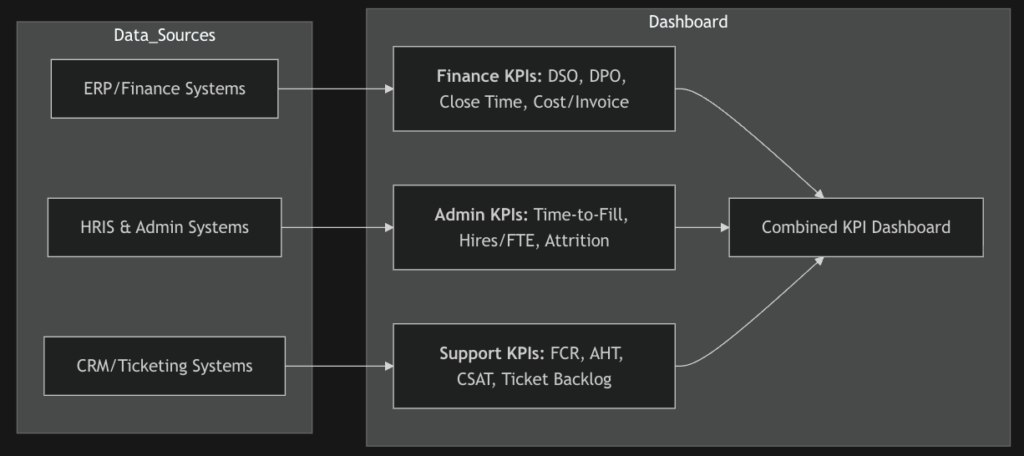
A KPI dashboard for FAS functions brings these metrics into focus. Ideally, data from ERP/finance systems, HRIS, CRM and ticketing tools feed a BI dashboard. For example:
- A Finance dashboard might display DSO (trend line), DPO, close time (gauge), invoice volumes (bar chart), and variance vs targets.
- An Admin dashboard could show hiring throughput, open reqs, FTE ratios, and support ticket statistics.
- A Support dashboard would include metrics like AHT and FCR (gauges), ticket backlog (trend), and CSAT/NPS (scorecards).
These visuals allow quick scanning of health and trends. Recommended charts include bar graphs of transactions/FTE, line charts of aging or monthly throughput, and pie charts for resource allocation. A balanced scorecard view by role function helps identify underperforming areas. Below is a conceptual flow of how data sources feed into KPI categories and a unified dashboard:
Recommended dashboards aggregate metrics by role and business unit, with drill-down capability. For example, a CFO dashboard might contain charts for overall finance KPIs, while an admin manager’s dashboard highlights HR and facilities metrics. Dynamic, real-time dashboards (using tools like Power BI, Tableau, or in-built ERP analytics) enable continuous monitoring and alerts (e.g. SLA breaches).
Tools and Automation Impact
Modern tools have a major impact on productivity across finance, admin, and support functions. ERP platforms, RPA tools, AI and OCR technologies, and IT service management systems all play a role in increasing throughput, improving accuracy, and reducing manual effort.
ERP and integrated finance systems such as SAP and Oracle provide a single source of truth across processes, which helps reduce manual reconciliation and supports more reliable reporting. A strong ERP environment can automate key activities such as general ledger close tasks, bank-feed matching, workflow routing, and management reporting. This kind of integration is often the foundation for better dashboards and more consistent process control.
RPA and AI have become especially important in transactional and repeatable workflows. By 2022, most large organizations had already adopted some form of RPA or intelligent document processing in finance operations. RPA bots are particularly effective for repetitive tasks such as invoice capture, bank reconciliation, and data entry, with reported accuracy levels of around 99.8% in areas like AP entry. AI and agentic AI add another layer by helping classify documents, detect anomalies, and surface exceptions automatically. In many cases, organizations using AI-enabled workflows report process-speed improvements in the range of 30% to 50%, with as much as 70% of manual effort removed.
One enterprise AI rollout reportedly reduced routine work by 70% and cut cash-application errors in half. Telkomsel, using a combination of RPA and intelligent document processing, automated around 100 processes and saved more than 110,000 labor hours per month in 2021. In another accounts payable example, automating approvals and coding increased daily invoice output per user from 57 to 92, representing a 60% productivity gain.
ERP-embedded automation also contributes significantly. Features such as workflow approvals, automated accrual posting, and straight-through purchase-to-pay processing can shorten close cycles and speed up payment execution. In service and support environments, platforms like ServiceNow and Zendesk improve productivity by making SLA tracking, workflow routing, and self-service easier to manage. Automated escalations, for example, can help teams maintain high compliance with service targets even as ticket volumes rise.
Cloud and mobile tools also matter, especially in remote and hybrid operating models. In markets such as the Philippines, where distributed BPO delivery has become increasingly common, remote-friendly systems help maintain output and accountability even when teams are not operating from a centralized office.
Overall, industry estimates suggest that ERP improvements and process automation can drive efficiency gains of roughly 25% to 50%, shorten process times by 30% to 50%, reduce errors by 60% to 95%, and lower labor-intensive operating costs by around 40% to 70%.
The case evidence supports this pattern. One company that applied RPA to accounts payable reconciliation reduced task volume by 42% while reaching 99.8% accuracy. Another introduced agentic AI into accounts receivable and cut DSO by 15 days. Taken together, these examples show that the combination of ERP, RPA, and AI can deliver not just incremental improvement, but meaningful transformation across finance, admin, and support functions.
Implementation Roadmap & Change Management
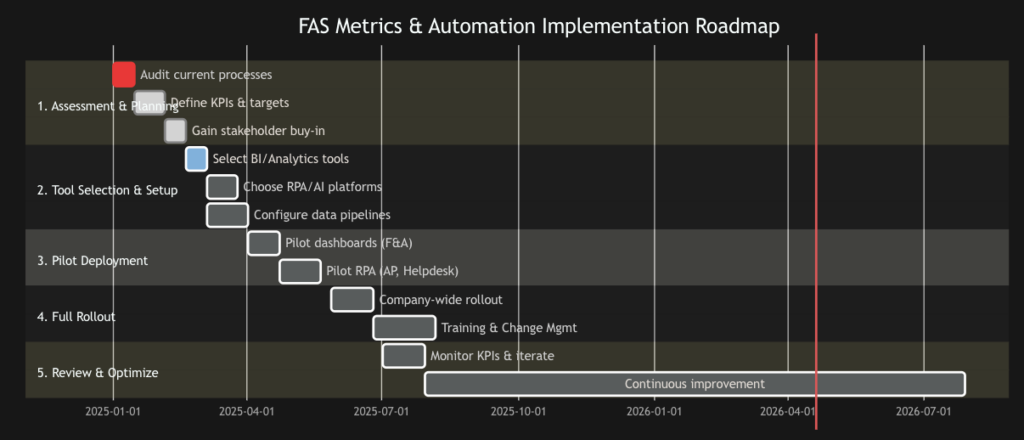
Implementing productivity metrics and automation across finance, admin, and support functions is usually best approached as a phased effort rather than a single rollout.
- Assessment (1–2 months):
The first stage is assessment, which typically takes one to two months. During this phase, the goal is to review current processes, map existing systems, identify available data sources, and understand where the biggest gaps are. This is also the point where current KPIs, reporting practices, and operational bottlenecks should be documented.
- Define Metrics & Targets:
Once that baseline is clear, the next step is to define the metrics and targets that will matter most. This should be done with input from business stakeholders, operations leaders, and process owners so that KPI definitions, formulas, and target levels are agreed upfront. At this stage, it is also important to establish data governance by assigning ownership for each metric and clarifying how performance will be maintained over time.
- Technology Selection:
Organizations need to choose the BI and reporting tools that will support dashboarding, as well as the automation platforms that fit the use case. This could include tools such as Power BI or Qlik for reporting and platforms such as UiPath for automation. If ERP enhancements or integrations are required, those should also be scoped during this phase.
- Data Integration & Dashboard Design:
From there, the focus moves to data integration and dashboard design. This usually involves building the pipelines needed to bring data from ERP, CRM, HRIS, ticketing, and other operational systems into a centralized reporting environment such as a data warehouse. At the same time, KPI dashboards and scorecards should be designed with the end user in mind, often starting with mockups before moving into production.
- Pilot Projects:
Rather than trying to automate everything at once, organizations typically get better results by starting with a few high-impact use cases. That might mean automating invoice entry in AP, introducing reconciliation workflows in AR, or launching a dashboard for support operations. The purpose of the pilot stage is to test assumptions, measure early impact, and refine both the process and the reporting model before wider rollout.
- Rollout:
This is where dashboards, metrics, and automation are expanded across the broader finance, admin, and support environment. Training becomes especially important at this stage so that staff understand not only how to use the new tools, but also how the new KPIs will be interpreted and managed.
- Continuous Improvement:
Productivity management is not a one-time implementation. Teams need to review KPI trends regularly, update benchmarks as conditions change, and refine workflows based on what the data shows. Dashboard alerts, exception reporting, and recurring performance reviews can all help ensure that issues are identified early and that improvement becomes part of ongoing operations rather than a one-off project.
Change management is a critical part of any productivity or automation initiative. Stakeholders need to understand not just the new metrics and dashboards, but also why they matter. Framing data transparency as a tool for better decision-making, rather than just oversight, helps build trust and encourages adoption across teams.
Training is equally important. Employees need support in learning new tools, workflows, and responsibilities, especially when automation changes the nature of their work. In practice, that may mean helping AR teams learn how to use an AI-based reconciliation platform or training finance staff to interpret dashboard-driven performance insights.
It is also important to communicate progress clearly and consistently. Visible wins, such as reducing close cycle time from seven days to four, help reinforce the value of the initiative and maintain momentum. To keep the program effective over time, the roadmap should include regular feedback loops, with quarterly KPI reviews, process adjustments, and updates to targets as the operating environment evolves.
Risks and Mitigation
Common pitfalls include data integrity issues (inconsistent definitions or sources), change resistance (staff skeptical of monitoring), and vendor SLAs that prioritize outputs over outcomes. Risk mitigation steps:
- Establish data governance with clear definitions and a single source of truth. Ensure all parties agree on metric calculations (e.g. how DSO is computed).
- Address change resistance through communication and training. Involve teams in KPI-setting to gain buy-in. Highlight how metrics can reduce workload (e.g. fewer manual tasks).
- Guard against overemphasis on outputs: Don’t reward raw volume if quality suffers. Include error rate and customer satisfaction in scorecards.
- For outsourced vendors, avoid “black box” SLAs. Everest warns that without shared data and governance, outcome metrics can become aspirational. Include escalation clauses and right-to-audit in contracts.
- Manage scope creep: Roll out metrics and automation in waves. Avoid chasing too many KPIs at once.
- Anticipate technical challenges: RPA/AI projects can stall without clean data. Pilot on well-defined subprocesses first.
By identifying these risks early and applying governance and transparency, organizations can ensure the initiative succeeds.
SLAs and Vendor KPIs in Contracts
When outsourcing FAS functions, SLAs should align with key productivity metrics and business outcomes. Move beyond “hours billed” to outcome-based SLAs. Examples of vendor KPIs and SLAs:
- Accounts Payable Vendor: Invoice processing turnaround (e.g. 90% invoices entered within 1 business day), invoice exception resolution time, data accuracy (99.9%), DPO improvement target, discount capture rate.
- Accounts Receivable Vendor: Days Sales Outstanding / DSO improvement, unapplied cash % (e.g. <1%), cash application timeliness (e.g. 95% within same day), collection success rate, CEI.
- GL/Payroll Vendor: Month-end close time, payroll error rate, payroll on-time delivery % (e.g. 100% on time), audit adjustments per period.
- Support Vendor: SLA compliance (e.g. 80% calls answered in 30s), First-Contact Resolution %, Customer Satisfaction %, technician utilization.
- Procurement Vendor: PO cycle time, contract compliance, savings delivered (e.g. % of spend under contract, cost reduction vs. market), vendor on-time delivery.
Everest Group recommends tying vendor incentives to business outcomes such as DSO improvement or stronger customer retention. In practice, that could mean offering a performance bonus when a provider exceeds a defined DSO reduction target. On the other side, penalties for missing key quality or turnaround commitments, such as invoice error rates above 1% or repeated SLA misses, help maintain accountability and balance the incentive structure.
To make this work, performance visibility needs to be shared. Dashboards tied to each SLA should be accessible to both buyer and vendor so that targets, variances, and trends can be reviewed from the same data set.
In summary, the most effective SLAs are role-specific and built around the right mix of time, quality, and cost metrics. When they are grounded in the productivity measures outlined above, they help align vendor performance with broader business goals rather than simple activity volume.
The data and benchmarks referenced here are drawn from industry sources and published reports, including recent IBPAP figures for 2024 to provide Philippines-specific context. Taken together, this framework gives finance, admin, and support leaders a practical basis for measuring, managing, and improving productivity across their operations.
Offshore 24/7: Better Metrics, Better Performance
The right productivity metrics do more than track activity. They help improve SLAs, strengthen accountability, and create better business outcomes.
At Offshore 24/7, we help companies build offshore finance, admin, and support teams around clear KPIs, stronger workflows, and measurable performance. From reporting frameworks to scalable delivery in the Philippines, we turn productivity data into practical operational improvement.
If you are looking to improve efficiency, service quality, or visibility across your offshore functions, Offshore 24/7 can help you build the right structure to support it.