
Redmako Learning reduced labour costs by embedding Philippines-based offshore staff across support, tutoring, compliance, and back-office functions.
Company
Redmako Learning
Services Provided
- Customer and student support operations
- Enrolment and course administration support
- Tutoring and learner progression support
- Marketing and business development support
- Quality and compliance support
- Operational back-office support
Industry
Education (Registered Training Organisation – RTO)
Locations
- Australia (Queensland-based RTO operations)
- Philippines (offshore delivery through PeoplePartners)
Operating Model
- Offshore execution was integrated into Redmako’s operating model across student support and business functions.
- Philippines-based staff supported delivery, administration, compliance, and student progression while Redmako continued operating as the Australian RTO.
Delivery Structure
- Work was distributed across multiple functions, including marketing, enrolment, tutoring, compliance, resource development, and finance support.
- Offshore staff were assigned into specialist roles rather than used as a generic shared pool.
Why This Approach
Redmako needed to keep service quality high while operating in a VET environment dealing with funding pressure and growing workloads. The business needed more support across enrolments, student assistance, compliance, and business development, but without pushing more pressure onto trainers or increasing local labour costs at the same pace.
Success Snapshot
Performance Drivers
- Labour costs were reduced by up to 70%.
- Operational support expanded across a large part of the business.
- Trainers had more time to focus on their core responsibilities.
- Students received more regular follow-up and support from enrolment through to completion.
- Redmako said it was better able to deliver the level of service it wanted for both students and clients.
Outcomes
- Labour costs were reduced by up to 70%.
- Operational support expanded across a considerable segment of Redmako’s business.
- Trainers gained more time and bandwidth to focus on their core duties.
- Students received more consistent follow-up and support from enrolment through completion.
- Redmako reported improved ability to deliver the level of service it wanted to provide to students and clients.
Company Background
Redmako Learning is a Queensland-based Australian RTO delivering qualifications in business and marketing, food safety, and hospitality. It provides training and vocational courses in schools as well as traineeships and apprenticeships in businesses. The organisation positions its service around experienced trainers and strong student support, including progress monitoring, consultations, and encouragement throughout the learner journey.
That service model creates operational demands beyond teaching alone. To sustain student outcomes, Redmako needed consistent execution across enrolment, documentation, tutoring, learner follow-up, and compliance-related activities. As with many education providers, service quality depended not only on instructional capability but on the reliability of the surrounding support system.
Industry and Operating Context
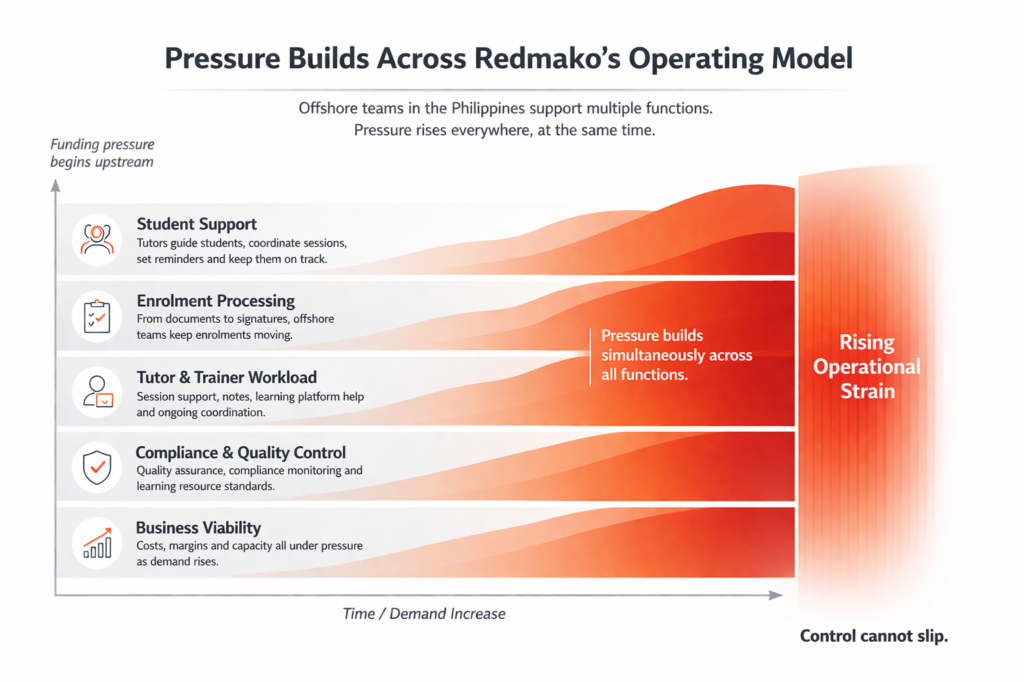
Funding changes and cuts in the VET sector can put pressure on the level of service that providers are able to maintain. For some organisations, that can mean bigger class sizes, heavier workloads for remaining staff, and more pressure on the business overall.
That pressure usually builds across the whole operation. Student support still has to stay responsive. Enrolments still need to move. Tutors and trainers still need to keep learners progressing and completing. Compliance and quality still need attention. For RTOs, the challenge is not simply about growing, but also about keeping service quality and operational control in place while managing costs.
Core Problem
Redmako needed extra support across several parts of the business, including marketing, business development, enrolments, tutoring, student support, and quality and compliance. It needed a way to add capacity across all of those areas without lowering service standards or putting more strain on its local team.
One clear pressure point showed up in student delivery. Redmako saw that trainers were busy, but that activity did not always turn into completed units. There was not enough attention on each student’s individual progress. Admin work and follow-ups were taking up time that trainers could have spent motivating learners and helping them finish.
So the business needed stronger execution support around the training function, along with wider support across operations and compliance, while keeping its overall service model intact.
Outsourcing Solution
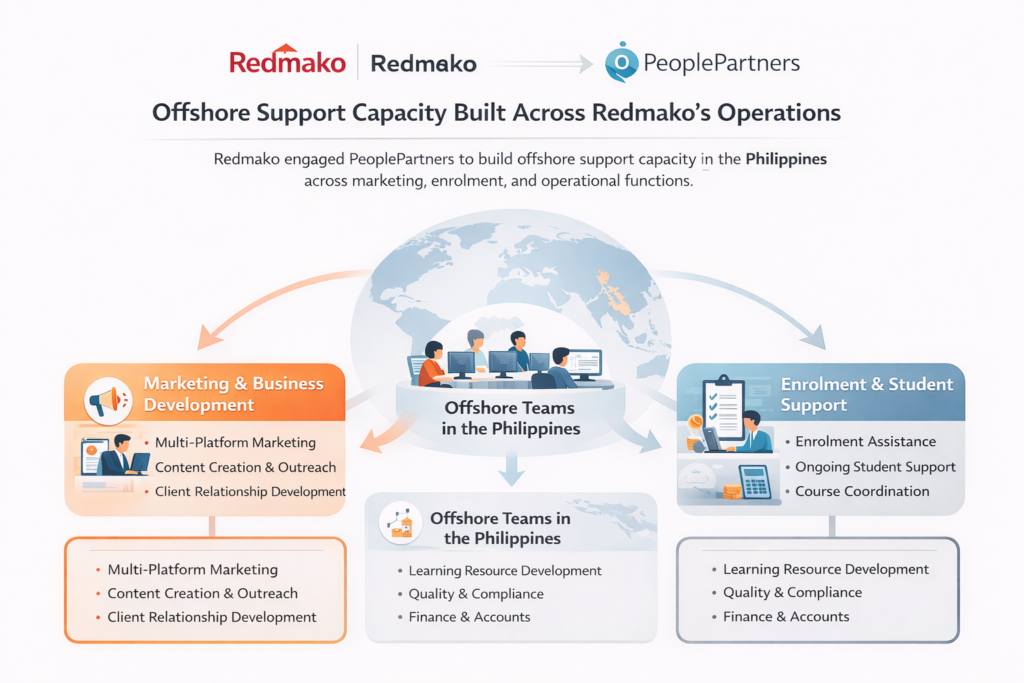
Redmako worked with PeoplePartners to build offshore support capacity in the Philippines across several parts of the business. This was not a small or isolated support setup. It covered student-facing support, commercial support, and back-office work.
On the marketing and business development side, PeoplePartners sourced staff to help Redmako attract new students and clients through multi-platform marketing. That included creating digital content for the website, blog, and social media, as well as supporting business development activity to help identify and build client relationships.
For enrolment and student support, offshore tutors were assigned to guide students from sign-up through to completion. They followed up on documents, signatures, reports, and other course requirements. They also helped coordinate face-to-face sessions, sent reminders, supported students on the learning platform, and helped keep learners on track with online and theory work. They also worked with trainers to prepare student notes from sessions.
Beyond that, offshore staff also supported learning resource development, quality and compliance, and finance and accounts. According to the case, a considerable part of Redmako’s operation was either managed or supported through these offshore roles.
The role mix included resource developers, instructional designers, compliance officers, student support staff and tutors, sales coordinators, marketing assistants, graphic and multimedia designers, and accountants. That points to a function-based model where offshore staff were placed into defined business roles, not just used for overflow or one-off tasks.
Results
The offshore model gave Redmako both cost savings and operational support. The clearest measured result in the case was a labour cost reduction of up to 70%, which Redmako linked to improved business viability and its ability to keep thriving.
With offshore tutors handling follow-ups, coordination, and student support tasks, trainers had more time and mental space to focus on their main responsibilities. Students received more structured help to stay on track with their studies and course requirements. This helped create a better student journey and stronger progress through courses.
More broadly, the model expanded execution support across a large part of the business, including student support, compliance, learning resources, finance, marketing, and client development.
Takeaway:
Redmako did not use offshore staffing only to cut costs. It used it to strengthen the support layers that keep an RTO running well.
Conclusion
The main challenge in this case was not just about needing more staff. It was about keeping service quality, student progress, and operational support in place in a VET environment dealing with cost pressure and rising workloads.
Redmako addressed that challenge by building a Philippines-based offshore team across multiple parts of the business. Tutors helped with student follow-up and paperwork so trainers could focus more on completions. Offshore specialists also supported compliance, learning resources, finance, marketing, and business development. That made the setup much broader than standard support outsourcing.
For RTO operators dealing with similar pressure, offshore support can work well when roles are clearly defined around real operational needs and tied directly to day-to-day workflow. The real value comes from building enough structured support around the training function so the business stays viable while still delivering the experience it wants students and clients to have.
Offshore 24/7 helps RTOs strengthen the support layers around training delivery by building offshore teams that work inside existing workflows. Compliance oversight, training standards, and operational control stay with the Australian provider. The offshore team supports the day-to-day execution that helps keep students progressing, trainers focused, and service levels consistent.