
Applied Education increased support and assessment capacity by embedding a Philippines-based team into regulated workflows without relinquishing compliance control.
Company
Applied Education
Services Provided
- Customer support operations
- Assessment marking and feedback execution
Industry
Education (Registered Training Organisation – RTO)
Locations
- Australia (core operations)
- Philippines (offshore delivery via Brainbox)
Operating Model
- Offshore execution was embedded within internal workflows.
- Australian assessors retained oversight of compliance-critical functions.
Delivery Structure
- Work was divided between support handling and assessment execution.
- The offshore team scaled in phases based on workload demands
Why This Approach
The company needed to increase capacity without compromising quality.
Success Snapshot
Performance Drivers
- Offshore roles were clearly defined between support handling and assessment execution.
- The offshore team was embedded directly into live operational workflows.
- Australian-based assessors retained oversight of compliance-critical outputs.
- Capacity was increased gradually through a phased staffing approach.
Outcomes
- The offshore team scaled from 1 to ~12 staff.
- Execution capacity increased across both support and assessment workflows.
- Responsiveness to support requests improved (qualitative).
- Assessment workload handling improved under existing oversight structures (qualitative).
Company Background
Applied Education AU is a registered training organisation (RTO) in Australia specializing in online, self-paced courses in bookkeeping, accounting, payroll, and business. They focus on practical, industry-led training rather than just theory to help professionals upskill, with courses tailored to busy individuals.
Its operating model required consistent compliance with standards governing assessment quality, documentation, and student support. As delivery shifted toward more online-led interactions, the volume of both support requests and assessment work increased.
The challenge is maintaining consistent execution under compliance constraints as the workload expanded across multiple operational layers.
Industry and Operating Context
Education providers operating under RTO frameworks must manage both scale and compliance simultaneously. Assessment workflows require consistent throughput while maintaining accuracy, documentation standards, and audit readiness.
As delivery models shift online, support functions such as enrolments, enquiries, and student assistance become more volume-driven. These functions require fast response times while remaining aligned with institutional processes.
Internal teams often face pressure when both support demand and assessment workload increase at the same time. Execution capacity becomes a limiting factor, particularly when oversight requirements cannot be relaxed.
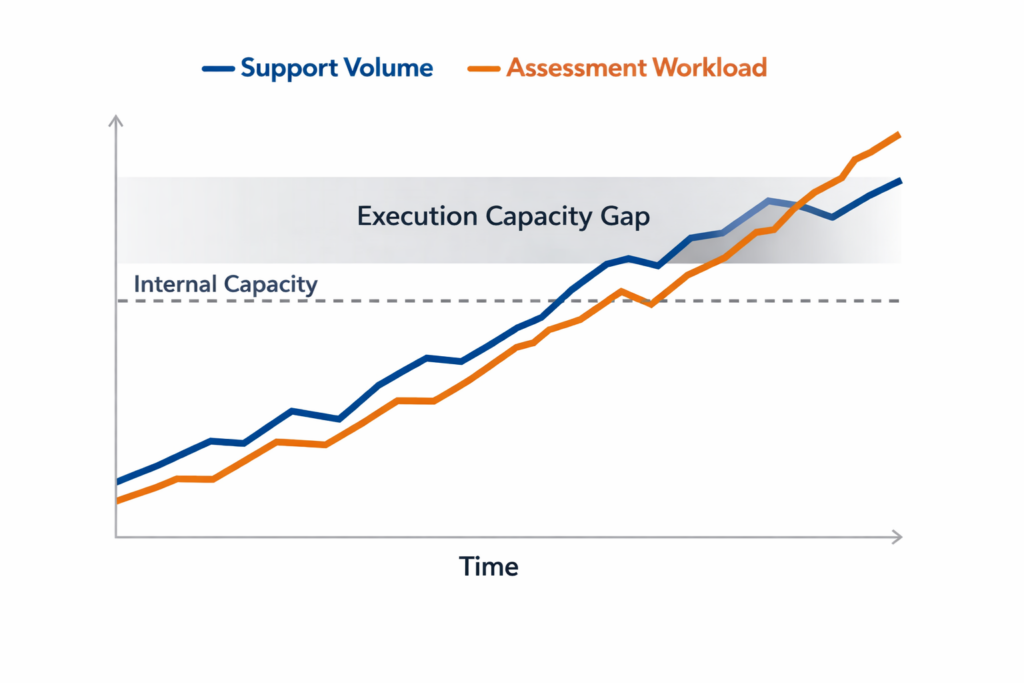
This environment creates a structural tension between throughput and control, especially in regulated education settings.
Core Problem
Applied Education began to experience pressure across both support and assessment workflows as demand increased.
- Support queues grew as more interactions moved to web-based channels.
- Assessment marking and feedback required consistent execution under compliance constraints.
- Internal capacity struggled to maintain responsiveness across both operational areas.
- Execution demands began to compete with the need for oversight and quality control.
The organisation faced a clear decision. It needed to increase execution capacity without compromising compliance control or significantly expanding its internal structure.
Outsourcing Solution
Applied Education implemented offshore staff augmentation through a Philippines-based team delivered via Brainbox. The model increased execution capacity while keeping compliance control within the internal team.
Customer support responsibilities were assigned to offshore staff, who handled enquiries, managed support queues, and contributed to knowledge-base development. This reduced pressure on internal teams managing front-line support queues.
Assessment execution support was also introduced through CPA-qualified offshore personnel. These roles focused on marking, feedback preparation, and back-office assessment tasks. Australian-based assessors retained oversight of outputs to ensure compliance requirements were met.
The offshore team was embedded directly into existing workflows rather than positioned as a separate external function. Responsibilities were clearly divided:
- Internal leadership retained control, validation, and compliance oversight.
- Offshore staff focused on execution and throughput across defined tasks.
The team was scaled gradually, starting with a single role and expanding to a multi-role structure aligned with workload growth.
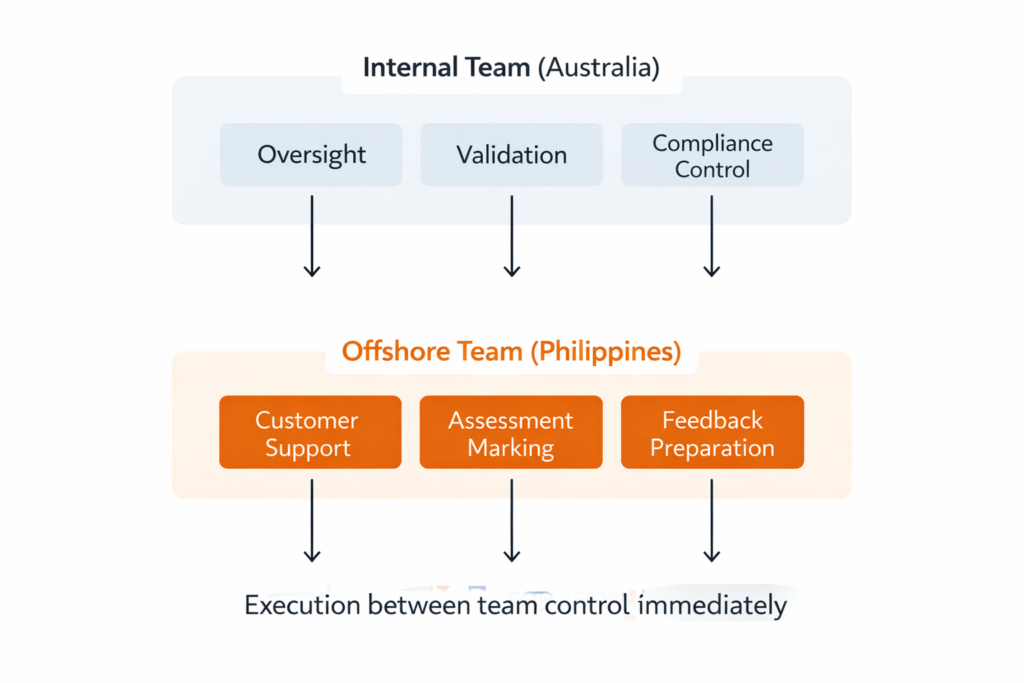
The structure separated execution from control, which allowed capacity to increase without changing governance.
Results
The introduction of offshore support increased execution capacity across both support and assessment workflows.
- The offshore team expanded from 1 to ~12 staff, increasing available execution coverage.
- Support responsiveness improved as queue handling capacity increased.
- Assessment throughput improved while oversight structures remained in place.
- Execution coverage expanded across both student support and assessment workflows.
No hard KPI or cost data was disclosed in the source material. Results are therefore based on qualitative descriptions and observed structural changes.
The outcome suggests that embedding offshore execution within controlled workflows can increase throughput without removing internal oversight layers.
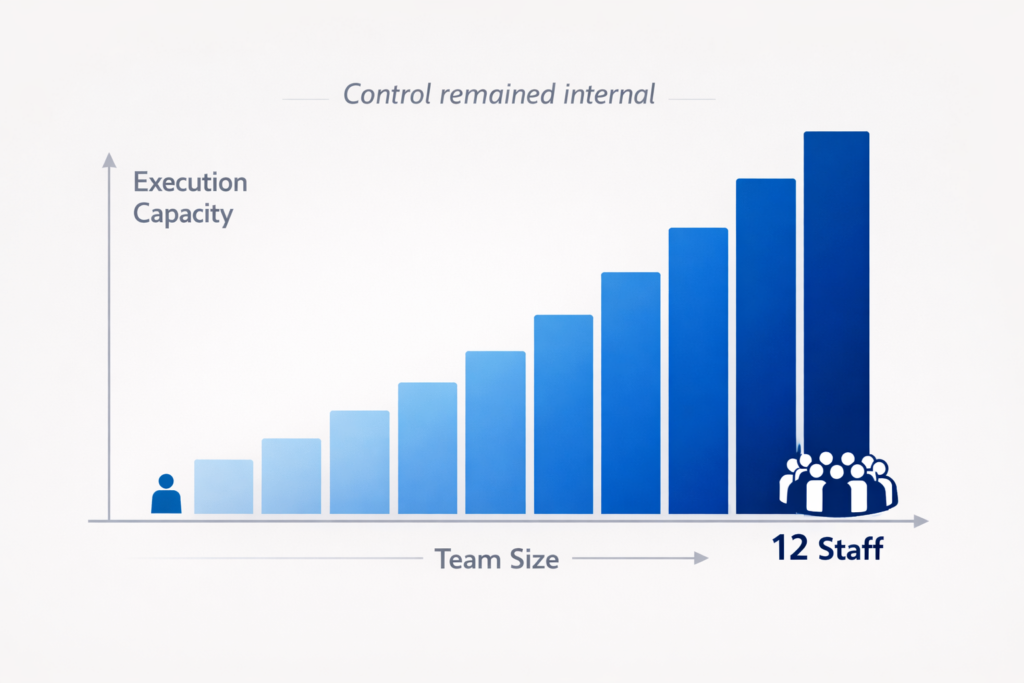
Takeaway:
Execution capacity increased without altering the organisation’s control structure over compliance-critical processes.
Conclusion
The constraint in this case was not demand or capability. It was the ability to sustain execution under compliance conditions as the workload increased.
Applied Education addressed this by adding an offshore execution layer while keeping control and validation internal. Execution was distributed, but governance did not move.
This structure matters for operators facing similar pressure. When support queues grow and assessment workloads increase, internal teams are often forced to choose between responsiveness and control. This case shows that both can be maintained if execution and oversight are separated correctly.
If your team is spending more time handling volume than maintaining quality, the issue is not headcount alone. It is how execution is structured.
Offshore 24/7 helps organisations build offshore teams that operate inside existing workflows while keeping decision-making, compliance, and quality control internal. The focus is not on outsourcing responsibility. It is extending execution capacity without changing how the business is governed.