
SnoozeShade kept revenue in the multi-million-pound range with a lean internal team by splitting routine work and specialist execution across offshore support and freelance contributors.
Company
SnoozeShade
Services Provided
Administrative support
Reporting support
Spreadsheet management
Order-related support
Specialist freelance marketing execution
Industry
E-commerce / Amazon-adjacent consumer brand
Locations
UK and the Philippines
Operating Model
Lean internal team with distributed outsourced execution
Delivery Structure
A Philippines-based VA handled structured operational work, while freelance specialists supported channel-specific execution
Why This Approach
The business needed to sustain growing demands without expanding into a broad in-house generalist team
Success Snapshot
Performance Drivers
- SnoozeShade separated recurring operational work from specialist marketing work so responsibilities stayed clear.
- A Philippines based VA handled structured support tasks instead of letting them pile onto founder time.
- Freelance specialists took on focused areas such as newsletters, TikTok, SEO, and ads.
- The setup helped the business stay lean while still keeping multiple workstreams moving.
Outcomes
- Best year revenue reached nearly £3 million
- The business continued trading at around £2 million
- The internal team stayed relatively small
- Delivery was supported by a VA and a group of specialist freelancers
Company Background
SnoozeShade is a consumer brand known for baby sun and sleep shades designed to create a calmer and safer environment for infants. It built its Amazon and wider ecommerce business around a deliberately lean structure. Instead of growing a large in house team, the company used outsourced support, including a Philippines based VA and specialist freelancers, to help manage recurring operational and marketing work.
Even with a small headcount, SnoozeShade operated at real scale. The founder described the company’s best year as nearly £3 million in revenue, with more recent trading at around £2 million a year.
So this was already a real business with solid revenue. The problem was not whether it could operate. The problem was how to keep output consistent as the amount of work grew across operations and marketing, without overloading a small internal team.
Industry and Operating Context
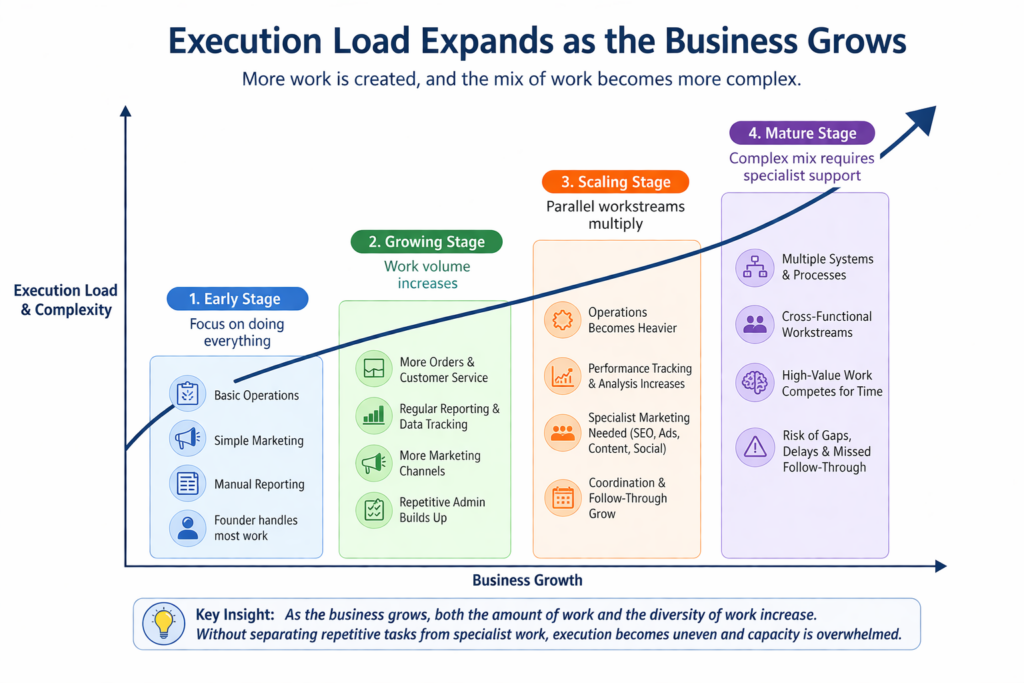
As ecommerce businesses grow, the work tends to build in layers. Admin work, reporting, order handling, and marketing all keep running at the same time, but they do not all require the same kind of skill or attention.
Some tasks are repetitive and need consistency. Others need specialist knowledge and better judgment. A lot of small businesses try to cover both through the same few generalist roles. That usually works for a while, but eventually it starts to create uneven execution and missed follow through on important but less visible work.
That is really the issue here. The problem is not just the total amount of work, but the mix of task types competing for limited time and attention.
This is why many lean ecommerce operators hit a point where generalist coverage is no longer enough. There is simply too much different work happening at once.
Core Problem
SnoozeShade was not short on direction or ambition. The business was trying to manage a widening range of recurring tasks through a small internal setup.
Over time, execution and oversight started competing for the same limited capacity. The same people were expected to keep routine work moving while also trying to manage specialist growth activity.
Practical Symptoms
- Administrative and reporting tasks needed regular attention, but often had to compete with more urgent work
- Spreadsheet-heavy and order-related tasks kept adding a recurring operational load
- Marketing functions such as newsletters, TikTok, SEO, and ads all needed different skill sets
- The internal team was stretched across too many kinds of work, which made consistency harder to maintain
At that point, the business had a choice. It could hire a few more broad in house generalists, or it could redesign execution so different types of work sat with the right type of support.
Outsourcing Solution
SnoozeShade moved to a task based outsourcing model that separated routine work from specialist work. The shift was not really about outsourcing more. It was about assigning work more intelligently.
A Philippines based VA took ownership of recurring operational tasks such as administration, reporting, spreadsheet management, and order related support. These were not glamorous tasks, but they were important and needed to be done consistently.
For narrower functions such as newsletters, TikTok, SEO, and advertising, the business worked with specialist freelancers. Those areas needed focused expertise, not broad general support.
The founder still kept coordination and oversight across all contributors. That meant priorities, deadlines, and quality expectations stayed aligned, even though execution was spread across different people.
That is what made the setup work. Offshore support was not treated like random overflow help. It became part of the business’s working model. It handled the repeatable day to day responsibilities so leadership could stay focused on decisions, priorities, and growth.
The following diagram shows how work was divided between the founder, offshore support, and specialist contributors.
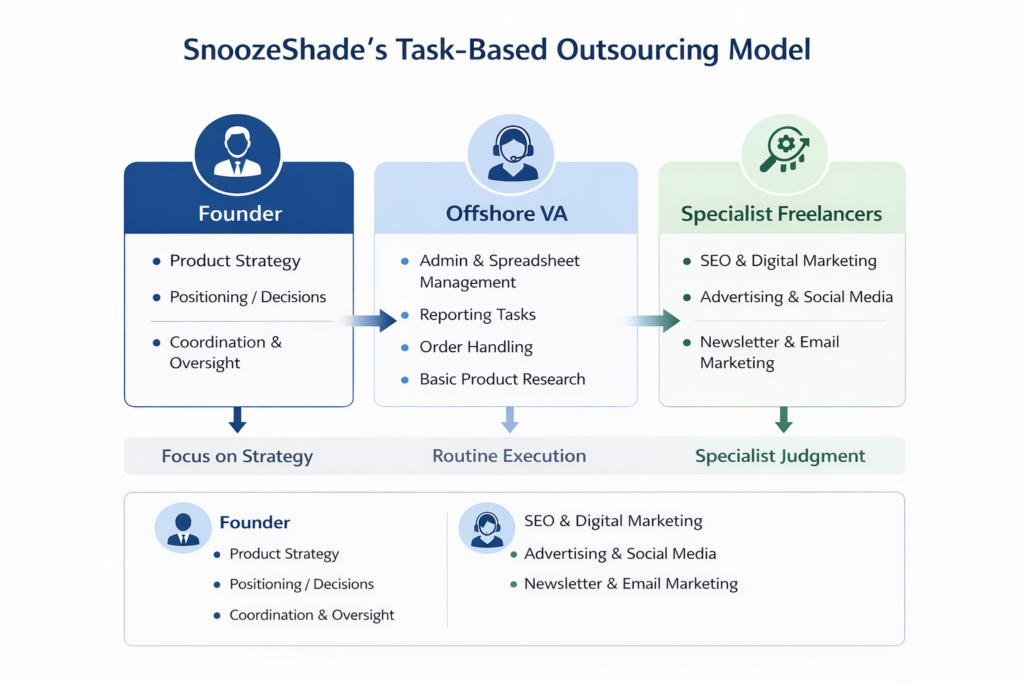
Routine work went to the offshore support layer. Specialist work went to people with the right expertise. Internal leadership stayed focused on coordination and direction.
Results
SnoozeShade reached nearly £3 million in its best year. The business later continued trading at around £2 million in annual revenue.
At the same time, the company kept its internal team lean while still supporting ongoing operations and specialist marketing execution. That matters because it shows the business was able to maintain meaningful revenue without building a large internal team.
The following chart compares output scale with team structure.
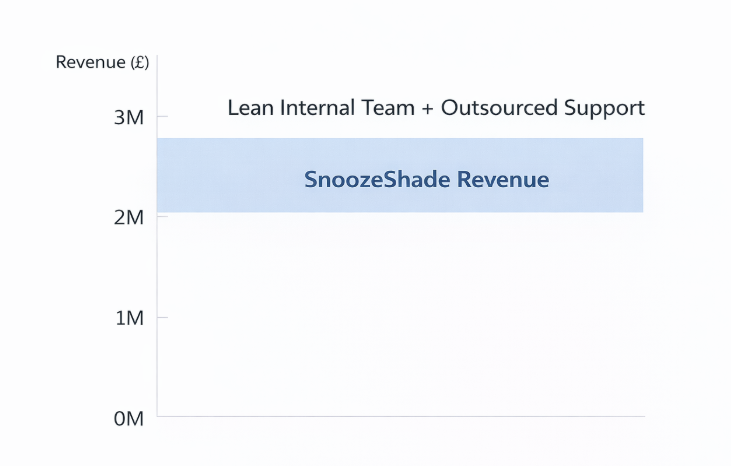
Team size was not the real limit. Execution capacity was.
By distributing work across offshore support and specialist freelancers, SnoozeShade was able to keep the business moving without forcing every task through the same small internal group.
Conclusion
SnoozeShade did not need more ideas. It needed a better way to keep very different kinds of work moving without overloading a lean team.
That is a common problem in growing ecommerce businesses. When recurring operational work and specialist marketing execution are pushed into the same few roles, consistency drops, and leadership attention gets pulled into too much detail.
That is where offshore support becomes useful in a very practical way.
A Philippines based support layer can take ownership of structured, repeatable work, while internal leadership stays focused on priorities, coordination, and commercial decisions. The value is not generic delegation. It is building a workflow where the right work sits with the right level of support.
Offshore 24/7 helps businesses build that kind of offshore structure so support is not sitting on the side. It becomes part of the day to day operation, helping lean teams stay consistent as the business grows.