
KSESTOR removed a founder bottleneck by handing off research and execution support to a Philippines-based virtual assistant, helping the business grow to $1.7 million without building a bigger internal team.
Company
KSESTOR
Services Provided
Product research support
Keyword tracking
Operational support
Industry
Amazon FBA / E-commerce
Operating Model
Founder-led brand with lean offshore execution support
Delivery Structure
Philippines-based VA embedded in product research and operating workflows
Why This Approach
KSESTOR needs to improve execution consistency around product decisions without overloading the founder with decision-making process and execution.
Success Snapshot
Performance Drivers
- The founder stayed focused on high value decisions instead of recurring support work.
- A Philippines based VA handled structured research and ongoing operating routines.
- Validation was built directly into the product development workflow.
- A lean offshore setup kept execution moving without growing headcount.
Outcomes
- More than $500,000 in first year revenue from one product launched in January 2025
- $1.7 million total revenue in 2025 across platforms
- Team size stayed in the 1 to 5 employee range
- No product failures reported after the validation process was put in place
Company Background
KSESTOR is a brand that sells premium hosting accessories, champagne towers, beverage dispensers, and cocktail serving equipment. Founded by Kseniia Reidel, the company focuses on products that are stylish, practical, and durable for both home entertaining and professional events.
It is also a very lean business. KSESTOR grew as a founder led Amazon brand with support from a Philippines-based VA and a small contractor bench, rather than a large internal team. That mattered because the business operated in a product category where mistakes could get expensive fast. Custom mold costs were reportedly around $7,000 to $8,000 per product, so product research and validation had to be done carefully.
Even with that level of risk, the brand grew to more than $500,000 in first year revenue from one product and reached $1.7 million in total 2025 revenue across platforms, all while staying in the 1 to 5 employee range.
KSESTOR was not starting from scratch. The business was already selling on Amazon and other channels, and the founder already had a process for product development, research, and validation. Tools like Helium 10 were already part of how the business operated.
So the problem was not whether the business could function. The real question was whether it could keep growing without the founder having to stay involved in every research and execution task behind each product decision.
Industry and Operating Context
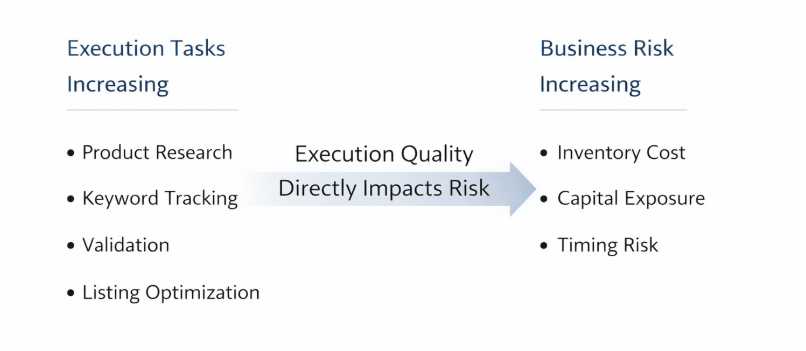
In Amazon FBA, growth does not just mean more sales. It also means more research, more validation work, more keyword tracking, and more operational follow through to launch and manage products properly.
These are repeatable tasks, but they still need to be done well and done consistently. At the same time, product decisions carry real financial risk through molds, samples, inventory commitments, and timing. So when execution slips, the cost is not just slower growth. It can also mean more expensive mistakes.
At a smaller size, a founder can usually keep up with this kind of work. Product research, validation, and coordination are still manageable. But once the business starts expanding, everything gets heavier at the same time. There are more product opportunities to review, more competitors to watch, and more tasks behind every launch.
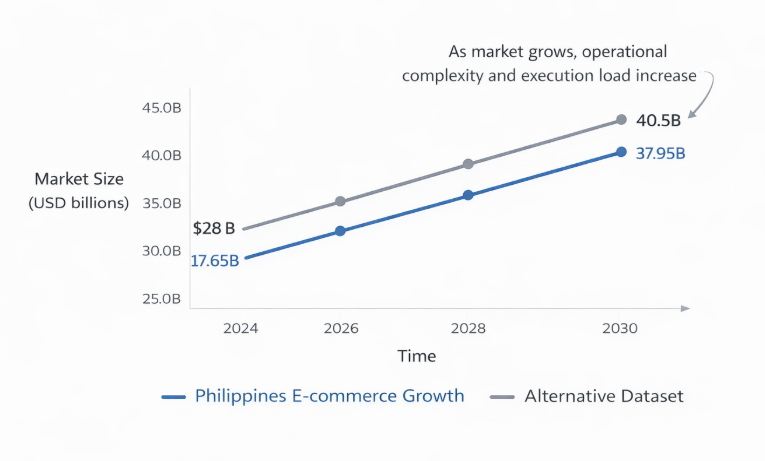
That is when execution starts turning into a real operating load.
In this kind of business, execution quality affects more than speed. It shapes financial risk, inventory decisions, and launch timing. That is why structured support becomes more valuable as the business grows.
Core Problem
The real bottleneck was founder bandwidth.
As KSESTOR expanded, the founder was still handling both high level product decisions and the recurring tasks needed to support those decisions. Over time, that created pressure on time, consistency, and focus.
A few areas made that especially clear:
- Product research needed regular attention
- Validation support had to be structured because the cost of getting it wrong was high
- Keyword tracking needed to be refreshed on a recurring cycle
- Operational follow through still needed to happen, even if it was not founder level work
At that point, the business had three basic options. It could keep doing everything internally and risk overload. It could hire in house and take on higher fixed costs early. Or it could outsource selected support work while keeping decision making with the founder.
That is really the key insight in this case. When a founder owns both judgment and execution, growth starts depending too heavily on personal capacity instead of a working system.
Insight: When founders remain responsible for both judgment and execution, scaling becomes dependent on personal capacity rather than system design.
Outsourcing Solution
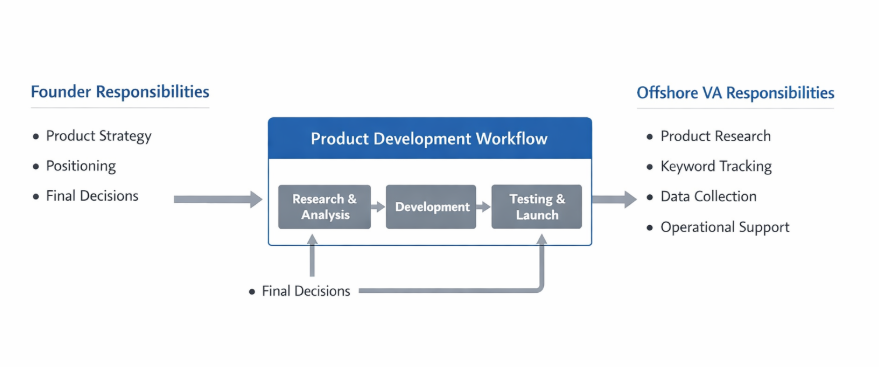
KSESTOR added a Philippines based VA as part of a lean offshore support setup. This was not treated like general admin help. The role was built directly into the product development workflow.
The VA supported:
- Product opportunity research using Helium 10
- Structured data gathering to narrow down viable opportunities
- Recurring keyword tracking and updates every 3 to 4 months
- Ongoing operational support tied to launch and review cycles
The founder retained responsibility for:
- Concept development
- Positioning and differentiation
- AI mockups
- Final validation and product decisions
The founder still kept control of the parts that mattered most, including concept development, positioning, differentiation, AI mockups, and final product decisions.
Risk control also stayed inside the process. Product concepts were validated using Helium 10 Audience with Amazon Prime members before samples were ordered.
That is what made the setup work. Offshore support did not replace founder judgment. It supported the repeatable work that made better decisions easier to make.
This separation gave the founder more room to focus on product direction, while execution kept running in the background in a more consistent way.
Results
This shift in execution support led to clear business results.
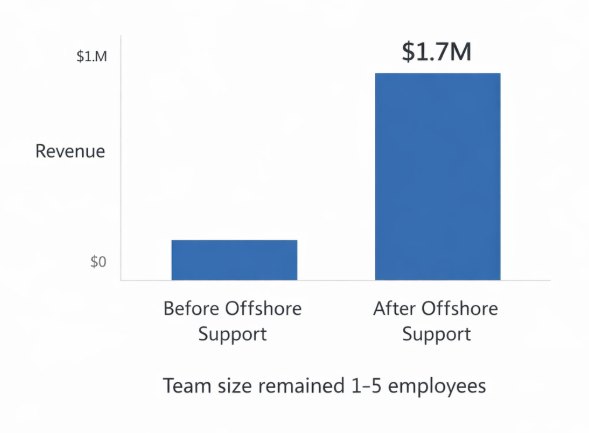
One product generated more than $500,000 in first year revenue after launching in January 2025. Total 2025 revenue across platforms reached $1.7 million. The team stayed lean at just 1 to 5 employees. The business also reported no product failures after putting the validation process in place.
What this suggests is pretty straightforward. Once research, tracking, and validation became more structured, the business was able to improve decision quality without adding more internal complexity.
Growth increased without expanding the team, which points to execution capacity, not headcount, as the real limiting factor.
Conclusion
KSESTOR shows something a lot of growing Amazon businesses run into. The issue is often not whether the founder can make strong decisions. It is whether the business is set up to support those decisions consistently.
When one person is responsible for strategy, research, tracking, and follow through, growth starts to get fragile. The business may still look healthy from the outside, but internally, progress depends too much on how much one person can carry.
This case points to a more durable setup. Keep strategic ownership with the founder. Move repeatable execution into a structured offshore support layer. Build validation into the workflow before capital gets committed.
If a business still depends on senior time for recurring research, product support work, or operational follow through, the bottleneck is probably already there.
Offshore 24/7 helps businesses build offshore support teams that fit into their existing workflows, so day to day execution stays consistent while leadership stays focused on bigger growth decisions.