

Executive Summary
Outsourcing to the Philippines can reduce labor costs significantly while giving businesses access to a large, skilled workforce with strong English proficiency. For example, a mid-level Filipino customer support agent may cost around $6 to $8 per hour, or roughly ₱350 to ₱480 per hour, including benefits. That is often only about 25% to 30% of the cost of a comparable US-based role.
Still, the real total cost of ownership goes well beyond hourly wages. A proper TCO view should account for both direct and indirect costs, including salaries and statutory benefits, recruitment and training, office infrastructure or remote-work setup, equipment and software, telecom and utilities, taxes and compliance, vendor margins, currency risk, transition costs, and hidden overruns such as turnover and management overhead.
Based on industry data and salary surveys from 2020 to 2026, typical monthly salaries in the Philippines generally fall within a clear range by function.
- Customer Service/CSRs ₱20–40K ($400–$800)
- Technical Support ₱25–50K ($600–$1,200)
- Back-office/Data Entry ₱15–25K ($350–$600)
- Accountants/Finance ₱30–70K ($750–$1,750)
- Sales/BD ₱30–80K ($750–$2,000)
- Software Developers/IT ₱60–150K ($1,500–$3,800).
Viewed annually, these figures translate into total onshore-equivalent compensation of roughly $5,000 to $20,000 for service-oriented roles and around $12,000 to $50,000 for IT and finance functions, depending on seniority and specialization. For context, typical offshore personnel costs are around $10,000 to $12,000 per year, including benefits, compared with roughly $50,000 to $70,000 in the United States for similar roles.
To make the economics more practical, we built illustrative TCO models for three team sizes: a small team of 5 FTEs, a mid-sized team of 25 FTEs, and a large team of 200 FTEs. Each model was assessed under two operating scenarios: an on-premise office setup and a hybrid or remote model. These scenarios include both one-time costs and recurring costs. One-time costs typically cover recruitment, training, furnishing, and equipment, while recurring costs include wages, statutory contributions, 13th-month pay, office rent or remote stipends, software licenses, telecom, and management overhead.
Across every model, offshore delivery remains materially less expensive than a fully onshore setup, even after transition costs, oversight, and contingency are included. In one case study, annual infrastructure costs, including rent, power, and IT, were estimated at around $240,000 for 50 seats in the Philippines compared with $512,000 for a similar US office. The same labor pattern holds at the employee level: a Filipino support agent costing roughly $800 per month, including benefits, compares with a US-based agent closer to $4,500 per month. As a result, break-even tends to happen quickly. Even after accounting for setup and transition costs, the cumulative cost of a Philippine team can fall below onshore costs within a matter of months, often producing savings of 50% to 60% or more.
That said, cost is only part of the TCO picture. Non-cost factors also shape the real financial outcome. Quality and productivity matter, and Filipino professionals are generally regarded as skilled, trainable, and strong communicators, though some roles may require additional domain-specific ramp-up. Attrition is another major factor. Industry turnover can run at roughly 30% to 40% annually, which increases replacement costs and creates downtime. Time zone differences also affect operating efficiency. The Philippines operates on GMT+8, which may reduce real-time overlap with Western clients but can also be an advantage for businesses that need 24/7 support coverage.
Cultural fit also plays a role. The Philippines is known for high English fluency and a business culture that aligns well with Western markets, but some communication and workflow nuances still need to be managed. Security, intellectual property, and compliance are equally important. The country has data privacy laws in place, and established providers often follow recognized standards such as ISO and PCI. Even so, buyers still need strong contracts, NDAs, and operational controls. Regulatory considerations must also be built into the model. Philippine labor rules include 13th-month pay, leave entitlements, and mandatory social contributions, while corporate taxes and investment incentives such as PEZA may affect the final structure.
For procurement and TCO management, buyers should approach the process with the same discipline they would apply to any strategic vendor decision. A formal RFP and SLA framework is essential. Requirements should clearly define the scope of services, performance expectations, response and turnaround times, quality or accuracy benchmarks, uptime commitments, security standards, and compliance requirements. From a commercial standpoint, there are several levers buyers can use in negotiations, including larger committed volume, longer contract terms, clearer currency and inflation clauses, and bundled service arrangements.
A structured TCO worksheet can also help buyers compare options more accurately by breaking each cost category into clear formulas and assumptions. Just as important, every model should document the assumptions behind it, including exchange rates, wage growth, inflation, and any known data gaps such as provider-specific fees or taxes on foreign services.
Overall, the cost advantage of outsourcing to the Philippines is compelling, but the strongest decisions come from looking beyond wage arbitrage alone. The businesses that achieve the best outcomes are usually the ones that evaluate total cost in full, account for operating realities early, and structure procurement around both price and performance.
Key Cost Components
Labor (Salaries & Benefits)
Labor is typically the single largest cost component, often accounting for around 50% of total offshore spend. In the Philippines, entry-level service roles commonly start at around ₱20,000 to ₱30,000 per month, or roughly $400 to $600, while more senior or technical roles can reach ₱150,000 or more per month, or about $3,500 and above. Employers must also cover mandatory benefits, including the 13th-month bonus, Social Security System contributions, PhilHealth, and Pag-IBIG. Together, these statutory obligations usually add around 15% to 20% to gross salary. Once the 13th-month pay is included, the fully loaded labor cost per FTE is often about 20% to 30% higher than base wage alone. One industry analysis, for example, estimates that a Philippine-based support agent costs around $10,000 to $12,000 per year, including benefits.
Recruitment & Onboarding
Hiring costs should also be built into the model. Whether recruitment is handled by an agency or internally, fees often fall in the range of 15% to 25% of a new hire’s annual salary, or a fixed amount per hire. A practical planning assumption is around 15% of annual wage per new FTE. This usually covers job postings, screening, interviewing, and administrative support. Onboarding adds further cost, especially when new hires require structured training, supervised ramp-up, or support from internal trainers. In many cases, onboarding can add the equivalent of 0.1 to 0.2 months of salary per employee, not including trainer time.
Training
Training does not stop after onboarding. Ongoing upskilling, compliance refreshers, and technical certifications can add meaningful cost over time, especially in technical, finance, or regulated roles. A reasonable budget is around ₱5,000 to ₱10,000 per quarter per employee, or roughly $100 to $200, for learning materials, courses, and related development expenses.
Office Infrastructure (On-Premise)
For companies using a dedicated office setup, infrastructure costs can be substantial. These typically include rent, utilities, security, and facilities management. Office rents in key business districts in the Philippines, such as Metro Manila, often run at roughly $10 to $20 per square foot per year. At an estimated 50 to 75 square feet per employee, this can translate to around $500 to $1,000 per seat per month. Some BPO benchmarks place total infrastructure charges, including space, power, and internet, at around $300 to $500 per seat-month. For planning purposes, a working assumption of $400 per seat per month is often reasonable. Additional office-related costs may include electricity of roughly $50 per month per seat, internet connectivity, and general workspace support.
Remote and Hybrid Infrastructure
Remote or hybrid models reduce or eliminate dedicated office rent, but they still carry infrastructure costs. Employers may need to provide home internet stipends, co-working support, or workspace allowances. A common planning range is around $50 to $100 per employee per month for remote-work support, depending on the structure of the program.
Equipment & Technology
Each employee will typically require a workstation, whether in-office or remote. This may include a laptop or desktop, monitor, headset, and, in some cases, a phone setup. The one-time capital cost often falls between ₱30,000 and ₱70,000 per seat, or about $600 to $1,400. These costs are usually amortized over three to four years. On top of hardware, software, and licensing expenses should also be included. CRM tools, collaboration software, security tools, and productivity platforms can add around ₱1,000 to ₱3,000 per user per month, or roughly $20 to $60. Telecom services such as VoIP or mobile data may add another $10 to $20 per month.
Utilities & Communications
For on-premise teams, utilities remain a recurring cost category. Electricity, water, and communication services can together add around $50 to $100 per seat per month, particularly in higher-usage environments such as contact centers. For remote teams, these costs are usually lower and are often reflected through internet or connectivity reimbursements instead.
Payroll Taxes & Corporate Taxes
Beyond mandatory employee contributions such as SSS, PhilHealth, and Pag-IBIG, companies should also consider the corporate tax structure of their delivery model. Philippine subsidiaries are generally subject to a 25% corporate income tax. However, many outsourcing operations are structured as export services, and some providers operate under PEZA or other investment frameworks that may offer tax incentives. Because treatment can vary, buyers should confirm the tax setup directly with legal and finance advisors or with the provider.
Legal & Compliance
If a company is establishing its own local entity, legal, accounting, and licensing fees can add a meaningful upfront cost. A rough estimate for setup can range from $5,000 to $10,000 as a one-time expense. Businesses working through a BPO partner may not see these costs as a separate line item, but they are often embedded in the provider’s pricing. Ongoing compliance obligations, including privacy controls, contracts, and audits, may also require additional professional services spend.
Insurance
Insurance is usually a smaller cost category, but it should still be included in the model. Basic work-related coverage is generally embedded through statutory programs, but some employers also provide supplemental health or life insurance to improve retention and competitiveness. A planning range of around $100 to $200 per employee per year is a reasonable estimate for additional coverage.
Management/Overhead
Direct labor is only part of workforce cost. Employers also need to account for the local management structure required to support delivery. A common rule of thumb is one supervisor for every 10 to 15 staff and one HR or recruiting resource for roughly every 50 employees. When those roles are allocated across the operation, they can add about 10% in overhead on top of direct labor costs.
Vendor Margin & Fees
When working with a BPO provider, quoted rates typically include a margin for profit, management, and risk. In many cases, that markup ranges from 20% to 40% on top of underlying costs. Some vendors provide more transparent pricing that separates operating cost from markup, while others quote an all-in seat rate. From a procurement standpoint, it is important to negotiate visibility into what is actually included so buyers can distinguish real operating costs from provider margin.
Currency Risk
Exchange-rate fluctuations can affect the true cost of offshore delivery, particularly in long-term contracts. Changes in the PHP-USD rate can alter labor and operating expenses, especially when contracts are denominated in different currencies. Many agreements address this through fixed exchange assumptions, adjustment clauses, or hedging mechanisms. For larger deals, it is often prudent to include a currency buffer of around 5% to 10%.
Transition & Hidden Costs
Transition costs are often underestimated in early-stage models. Data migration, process transfer, change management, and early ramp inefficiencies can add roughly 5% to 10% to first-year cost. Attrition also creates recurring hidden costs, especially in high-turnover environments, because every replacement requires new hiring, onboarding, and training. Other hidden costs may include downtime caused by power interruptions, slower productivity during ramp-up, or added oversight from internal management teams. These costs do not always appear clearly in vendor proposals, but they can have a meaningful impact on real TCO.
Salary & Role Benchmarks
Below are typical salary ranges in the Philippines, particularly in Metro Manila, for common offshore roles. These are illustrative mid-2020s figures, and actual compensation will vary depending on location, experience, specialization, and employer. Even so, the contrast with equivalent onshore pay remains significant.
| Role / Tier | Monthly Salary (PHP) | Annual Total Cost (incl. benefits, USD) | Source/Citation |
| Customer Service Rep / CSR | ₱20,000 – ₱35,000 | ~$4,500–$8,000 (per year) | Payscale: median ~₱352k/yr |
| Tech Support Specialist | ₱25,000 – ₱45,000 | ~$6,000–$10,500 (per year) | Payscale: ₱294k avg/yr |
| Back-office / Data Entry | ₱15,000 – ₱25,000 | ~$3,800–$6,500 (per year) | Glassdoor: 17k–26k/mo |
| Finance/Accounting (mid) | ₱30,000 – ₱70,000 | ~$7,500–$18,000 (per year) | Payscale: ₱348k avg/yr |
| Sales/Business Dev | ₱30,000 – ₱80,000 | ~$7,500–$20,000 (per year) | Payscale: ₱365k avg/yr |
| Software Developer / Engineer | ₱60,000 – ₱150,000 (senior) | ~$15,000–$38,000 (per year) | Payscale: ₱395k avg/yr (30k–1,000k range) |
| Graphic/UI Designer | ₱30,000 – ₱60,000 | ~$7,500–$15,000 (per year) | Industry estimates |
| Content Moderator | ₱20,000 – ₱30,000 | ~$5,000–$7,500 (per year) | JobStreet: ~₱23–25k/mo |
These estimates reflect more than just base salary. They also include 13th-month pay and mandatory statutory contributions. For example, an employee earning ₱30,000 per month would cost roughly ₱384,000 annually in base salary, plus an additional ₱30,000 for 13th-month pay and around ₱46,000 in employer contributions, bringing the total to about ₱460,000 per year, or roughly $9,000. By comparison, a similar US-based role, such as a customer service representative, may cost more than $50,000 annually. One analysis suggests that offshore labor costs can be about 60% lower than onshore equivalents.
It is also worth noting that wages in Metro Manila tend to run around 10% to 20% higher than in provincial markets. As a result, companies hiring remote talent outside Manila may be able to achieve slightly lower labor costs while still accessing strong talent.
Sample Total Cost Models
We use three illustrative team sizes, 5 FTEs, 25 FTEs, and 200 FTEs, to compare two delivery setups: an on-premise office model and a remote or hybrid model.
These figures are directional rather than fixed, since actual costs will vary based on wage levels, office location, hiring mix, and provider pricing terms. All values are assumed in Philippine pesos; for a rough US dollar conversion, they can be divided by an estimated exchange rate of 56 PHP to 1 USD.
| Cost Category | Unit Basis | On-Premise (Office) | Remote/Hybrid |
| Employees (FTE) | 5 / 25 / 200 | 5 / 25 / 200 | 5 / 25 / 200 |
| Base Salary (annual) | ₱360K per FTE (₱30K×12) | ₱1.8M / ₱9.0M / ₱72.0M | (same as left) |
| 13th Month Pay (annual) | ₱30K per FTE | ₱0.15M / ₱0.75M / ₱6.0M | (same) |
| Social + Health Contributions<br/>(SSS, PHIC, Pag-IBIG) | ≈15% of annual pay | ₱0.27M / ₱1.35M / ₱10.8M | (same) |
| Total Compensation<br/>(Salary+13th+Contrib.) | =base+13th+contri | ₱2.22M / ₱11.1M / ₱88.8M | ₱2.22M / ₱11.1M / ₱88.8M |
| Recruitment & Training | ~0.15 * salary + training per hire | ₱0.36M / ₱1.80M / ₱14.40M | ₱0.36M / ₱1.80M / ₱14.40M |
| Office Rent | ₱25K per seat·month (FMC) | ₱0.075M / ₱0.375M / ₱3.0M | — (0 for remote) |
| Utilities & Internet | ₱3K per seat·month | ₱0.009M / ₱0.045M / ₱0.36M | ₱0.003M / ₱0.015M / ₱0.12M (stipend) |
| Equipment (capex) | ₱50K per seat (depreciated) | ₱0.250M / ₱1.25M / ₱10.0M | ₱0.250M / ₱1.25M / ₱10.0M |
| Software & Licenses | ₱1K per seat·month | ₱0.060M / ₱0.300M / ₱2.400M | ₱0.060M / ₱0.300M / ₱2.400M |
| Travel / Visits | 2 trips/yr manager ($500 ea) | $1K/yr (∼₱56K) each team | $1K/yr each |
| Management/Overhead | 1 supervisor/10 FTEs, ₱40K/mo | ₱0.024M / ₱0.120M / ₱0.960M | ₱0.024M / ₱0.120M / ₱0.960M |
| Vendor Margin / VAT | ~15% of subtotal | +₱0.42M / +₱2.10M / +₱16.8M | +₱0.37M / +₱1.85M / +₱14.8M |
| Contingency / Misc. | ~5% of total | +₱0.15M / +₱0.75M / +₱6.0M | +₱0.15M / +₱0.75M / +₱6.0M |
| Estimated Total (yr1) | (sum of above) | ₱4.53M / ₱22.65M / ₱181.7M | ₱3.49M / ₱17.45M / ₱140.5M |
The model uses rounded figures and assumes a base wage of ₱360,000 per FTE per year. The on-premise scenario assumes a dedicated office environment, while the remote or hybrid scenario assumes most employees work from home with only limited co-working or support costs. Management overhead, recruitment expense, and one-time setup costs, such as equipment and training, are prorated or annualized to reflect a more realistic total cost view.
Even in this simplified model, offshore remote or hybrid delivery comes out roughly 25% to 30% lower in cost than an on-premise setup across all team sizes. On a per-FTE basis, the biggest difference comes from office and infrastructure expense. In an on-premise model, rent, utilities, and facilities costs make up a substantial share of TCO. In a remote model, much of that is replaced by smaller stipends or connectivity support. Larger teams also tend to benefit more from economies of scale, especially in rent, management structure, and overhead allocation.
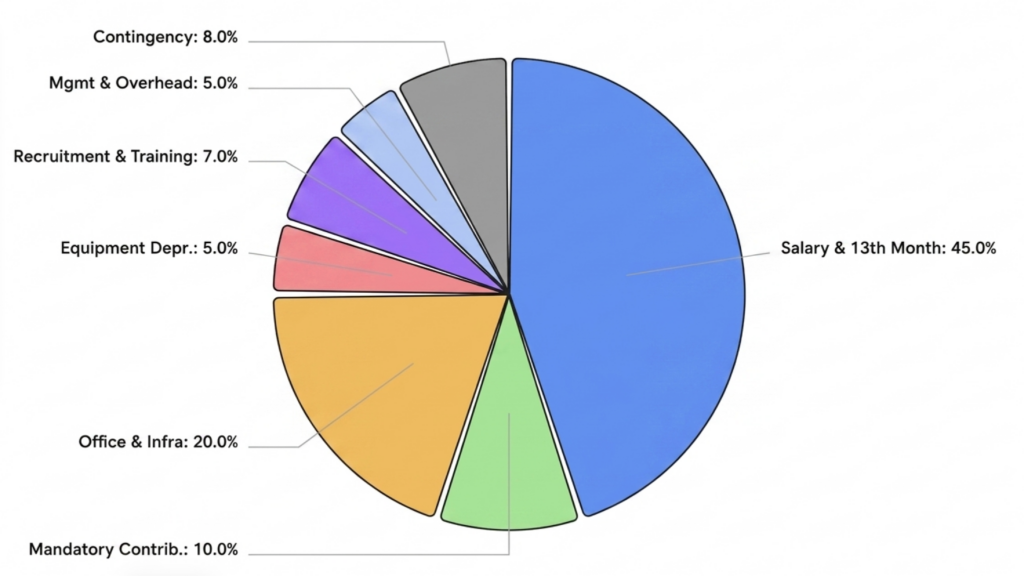
The same pattern becomes even clearer when compared with an equivalent onshore team. If cumulative spend is plotted over time for a US in-house team versus a Philippine offshore team, the onshore curve starts much higher because of larger salary, rent, and operating costs, while the offshore curve rises more gradually. The gap is wide enough that break-even often happens relatively early, in many cases within the first year. After that point, offshore delivery tends to generate increasingly meaningful savings. The analysis of a 50-FTE example found that first-year infrastructure costs alone were about $512,000 for an onshore setup versus roughly $240,000 offshore, which helps illustrate the scale of the difference.
Offshore vs Nearshore vs Onshore (Cost and Risk)
Although this guide focuses on the Philippines as an offshore destination, it is helpful to view that model alongside nearshore and onshore alternatives. Offshore delivery, particularly in markets like the Philippines, typically offers the lowest labor costs. Nearshore models, such as those in Mexico or Eastern Europe, tend to sit in the middle, often in the range of $15 to $30 per hour, while offering better time-zone overlap and, in some cases, closer cultural alignment. Onshore hiring remains the most expensive option, with rates often ranging from $60 to $120 per hour, but it also provides the highest level of direct control and oversight:
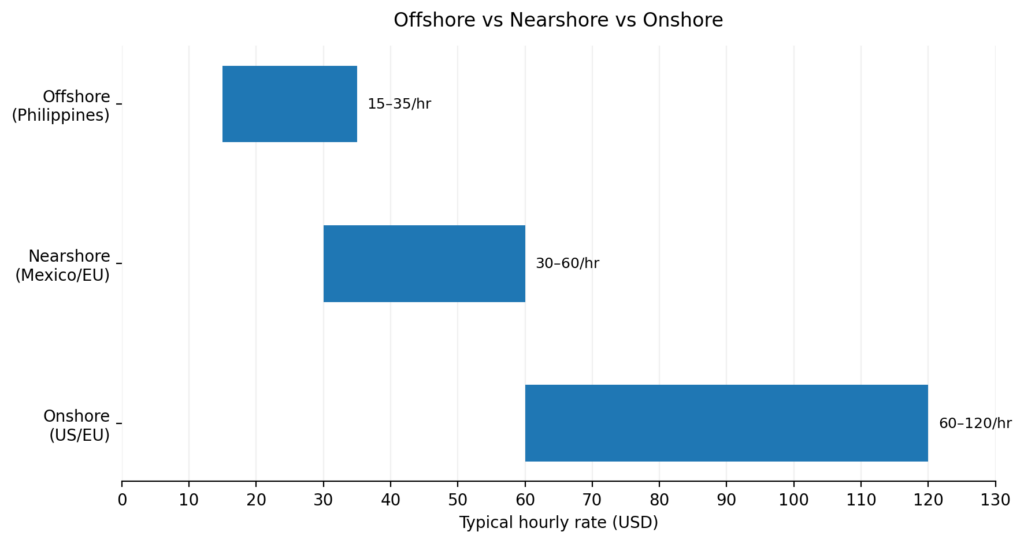
The trade-offs are fairly consistent. Offshore can deliver labor savings of roughly 50% to 60%, but those savings come with added complexity around distance, coordination, and turnover. Nearshore models often strike a balance between savings and collaboration. Onshore delivery is the most expensive, but it can simplify communication, governance, and day-to-day management.
The key point, however, is that the lowest hourly rate does not automatically translate into the lowest total cost of ownership. Hidden costs such as coordination friction, quality issues, ramp-up time, and management overhead can narrow the savings gap if they are not managed well. That is why many companies choose to start with a smaller pilot team before scaling, using the initial phase to test quality, operating fit, and the true cost of delivery.
Non-Cost Factors Affecting TCO
Quality & Productivity
Philippine BPO talent is generally well trained, highly English-proficient, and widely recognized for service-oriented work. Quality is usually maintained through structured training, quality assurance programs, and performance management. In practice, outcomes still depend heavily on how disciplined local leadership and operations management are. In knowledge-based roles, productivity may run about 5% to 15% lower than comparable US teams in some cases, but that difference is often more than offset by the labor cost advantage. The best way to evaluate this is not by assumption, but through clear KPIs such as accuracy, throughput, revenue contribution, turnaround time, or customer satisfaction.
Attrition & Morale
Attrition remains one of the biggest operating risks in the Philippine outsourcing market. In many BPO environments, annual turnover can run around 30% to 40%, which increases recruitment and training costs while also creating service disruption. That makes retention a direct TCO issue, not just an HR concern. Companies can reduce the impact by investing in employee engagement, career progression, manager quality, and retention incentives. Some businesses also use a mix of permanent and contract staffing to create more flexibility when turnover is high.
Cultural/Language
One of the Philippines’ strongest advantages is its high level of English fluency and strong familiarity with Western business norms. That generally makes communication easier and reduces friction in customer-facing and collaborative work. At the same time, buyers should still be aware of cultural nuances, including a more collective work style and, in some cases, more indirect communication patterns. Cross-cultural training on both sides can improve collaboration, strengthen feedback loops, and reduce misunderstandings over time.
Time Zone
The Philippines operates on UTC+8, which places it roughly 12 to 16 hours ahead of North America depending on the season and location. For US-based companies, this can reduce real-time overlap and require more structured handoffs, night-shift operations, or follow-the-sun workflows. That can create additional management complexity, but it can also be a major advantage for businesses that need 24/7 support coverage. For clients in Asia or parts of Europe, the overlap is usually much easier to manage.
IP/Security/Compliance
The Philippines has an established legal framework for data privacy, and many mature outsourcing providers operate under standards such as ISO and PCI. Even so, security and compliance should never be assumed. Clients should require strong NDAs, audit rights, access controls, and clear operational safeguards, including physical security measures such as badge access and CCTV where relevant. For highly sensitive work, some companies may prefer to offshore only non-core processes or use dedicated delivery environments to reduce exposure.
Regulatory Risk
Philippine labor law includes several mandatory requirements that affect long-term operating cost, including 13th-month pay, leave entitlements, and rules around termination and employee protections. If these are handled poorly, they can create unexpected cost and compliance exposure. Reputable providers typically already account for these obligations in their pricing, but buyers should still understand how they are being managed. It is also worth monitoring policy changes, such as wage-related proposals that could affect future labor costs in the sector.
Economic & Currency
Macroeconomic conditions also influence offshore TCO over time. The Philippine peso has been relatively stable in recent periods, at around PHP 56 to 57 against the US dollar, but inflation still affects the real cost of labor. For example, PSA data indicates that ₱1 in 2018 had the purchasing power of only about ₱0.75 by March 2026, implying roughly 25% inflation over that period. For that reason, contracts should ideally address wage movement, inflation, and currency fluctuations directly, either through adjustment clauses or some form of FX risk protection.
Procurement Guidance
- RFP/Selection Checklist
A strong outsourcing decision starts with a clearly defined business objective. In the RFP process, buyers should ask providers to spell out the scope of work, the required roles and skill sets, the proposed service levels, security controls, technology stack, staffing model, and full cost structure. It is also important to request client references and relevant case studies to validate delivery experience.
Beyond service capability, buyers should assess the provider’s financial stability and confirm that local registrations and licenses are in order, including items such as SEC registration or PEZA status where relevant.
Attrition is another critical area to review, so providers should be asked to share turnover data and explain their retention strategy. Finally, contracts should clearly address intellectual property ownership, confidentiality, and data protection obligations.
- SLA Metrics
Service levels should be defined in practical, measurable terms. The right metrics depend on the type of work being outsourced, but common examples include response time, resolution time, and first-call resolution for support functions; accuracy rates and defect rates for data-related work; turnaround time for processing functions; and CSAT or NPS for customer-facing operations. Schedule adherence, system uptime, and security incidents should also be monitored where relevant.
The key is to make targets specific and enforceable. For example, a support SLA might require 90% of inquiries to be answered within 30 seconds, while a back-office SLA might require data accuracy of at least 95%. Whatever the metric, accountability and remedies for underperformance should be clearly defined.
- Pricing Negotiation
Pricing should be negotiated with a full understanding of what is fixed, what is variable, and what may change over time. Vendors will often offer discounts of around 5% to 10% for larger headcount commitments or multi-year contracts, so scale and term length can create leverage. Buyers should also clarify how annual salary increases, inflation adjustments, and billing currency will be handled. If multiple providers or geographies are under consideration, competing quotes can be useful in negotiations.
It is equally important to confirm whether pricing is based on a seat model or an FTE model, since a seat-based price may already include infrastructure and support costs. Buyers should also ask whether they will be charged for unused bench capacity, excess hours, or any variable costs that may not be obvious in the initial quote.
Where possible, contracts should fix the billing currency, such as USD, or include a clearly defined FX mechanism.
- Cost Levers
There are several ways to improve cost efficiency without sacrificing delivery quality. One is to evaluate different engagement models, such as hiring through an Employer of Record versus working through a local BPO partner, since each comes with a different fee structure and risk profile.
Another is to confirm how tax treatment is being handled. Offshore services may qualify as export services, allowing some providers to zero-rate VAT, but this should be verified to avoid unexpected tax costs. Buyers can also use role design and productivity-based incentives to control costs more effectively, such as reserving premium pay for higher-skill work while maintaining leaner cost structures in more standardized functions.
- TCO Tools: A detailed spreadsheet model remains one of the most effective tools for procurement and cost control. Every major cost line should be broken out clearly so buyers can calculate both per-FTE and total program cost. This kind of transparency makes it easier to compare providers, pressure-test assumptions, and identify which categories are driving spend. In most cases, the clearer the cost model, the easier it is to manage TCO over time. For example:
| Cost Item | Per-Unit | Formula | Total (PHP) |
| Base Salary (per FTE) | ₱30,000 / month | =₱30,000 * 12 * FTE | e.g. ₱1,800,000 (for 5 FTEs) |
| 13th Month Pay | 1 mo salary | =₱30,000 * FTE | ₱150,000 (for 5 FTEs) |
| SSS/PH/Pag-IBIG (~15%) | 15% of annual salary | =0.15 * (₱30,000*12) * FTE | ₱270,000 |
| Total Compensation | sum of above | ₱2,220,000 | |
| Recruitment (15%) | 15% of annual cost | =0.15 * TotalCompensation | ₱333,000 |
| Training (per hire) | ₱10,000 | =₱10,000 * FTE | ₱50,000 |
| Office Rent | ₱25,000/mo/seat | =₱25,000 * 12 * FTE | ₱1,500,000 (if 5 seats) |
| Internet/Utilities | ₱3,000/mo/seat | =₱3,000 * 12 * FTE | ₱180,000 |
| Equipment (depr.) | ₱50,000 (5-yr life) | =₱50,000 * FTE / 5 | ₱50,000 (annualized) |
| Software/Telecom | ₱2,000/mo/seat | =₱2,000 * 12 * FTE | ₱120,000 |
| Management Overhead | ₱40,000/mo manager | =₱40,000 * #managers * 12 | ₱480,000 (if 1 manager) |
| Vendor Margin | 20% of subtotal | =0.20 * (sum of above costs) | ~₱xxx,xxx |
| Grand Total (USD) | Conversion | =TotalPHP / ExchangeRate | ~$YY,YYY |
Data Gaps & Assumptions
This analysis is based on Metro Manila salary levels and current exchange-rate assumptions. In practice, salaries in provincial markets may be around 10% to 20% lower. The model also assumes standard statutory contribution rates and a 15% vendor margin, although actual provider fees can vary meaningfully by structure and service scope.
Infrastructure costs are also directional. Office rent will depend heavily on location, particularly when comparing central business districts with more suburban sites. For this model, we used a moderate estimate of roughly ₱25,000 per seat per month. Benefits were estimated at around 15% of salary, although the actual percentage may be somewhat lower for higher earners because of statutory contribution caps.
The model further assumes that new hires are brought in at full salary immediately, with no ramp delay, and that utilization remains at 100%. In reality, both turnover and downtime can reduce productive capacity, which affects real-world TCO. Legal and tax conditions may also shift over time. For example, any future policy change such as a proposed wage floor for BPO workers could increase labor costs, particularly for entry-level roles.
For budgeting purposes, these figures should be treated as a planning baseline rather than a fixed forecast. Buyers should refine them using current vendor proposals, updated wage benchmarks, and local operating data before making final decisions.
Conclusion
Outsourcing to the Philippines continues to offer a strong cost advantage across most delivery models. When TCO is broken down carefully, the numbers typically still support significant savings, often in the range of 50% to 60%, even after accounting for overhead, setup, and operating complexity.
The real value, however, comes from looking beyond headline wage savings alone. Procurement teams that build detailed cost models, push for line-item clarity in provider contracts, and weigh non-cost factors such as quality, reliability, and operational risk are far more likely to make strong outsourcing decisions.
When approached with that level of rigor, offshore delivery in the Philippines can offer more than lower labor costs. It can provide a scalable, high-quality operating model that supports both efficiency and long-term business performance.
Build a Smarter Offshore Cost Strategy with Offshore 24/7
Outsourcing to the Philippines can deliver major savings, but the best results come from more than lower wage rates alone. The real advantage comes from building the right cost structure, choosing the right delivery model, and making sure quality, compliance, and scalability are built in from the start.
At Offshore 24/7, we help businesses evaluate the true cost of offshore hiring in the Philippines, from labor and infrastructure to transition planning, vendor structure, and long-term operational fit. Whether you are comparing on-premise versus remote teams, building a small pilot group, or planning a larger offshore operation, we help turn cost savings into a practical and sustainable outsourcing strategy.
If you are exploring offshore staffing in the Philippines, Offshore 24/7 can help you assess the numbers, reduce hidden costs, and design a model that fits your business goals.