

Executive Summary
The Philippine IT-BPM industry remains one of the world’s most important outsourcing markets, and its growth shows no signs of slowing down. The sector is projected to employ nearly 2.5 million people by 2028, building on steady expansion over the past several years. Employment reached around 1.7 million in 2023, up more than 8% from 2022, and rose to an estimated 1.84 million in 2024. By 2025, the industry is expected to cross the 2.0 million mark.
Several factors are driving this momentum. Foreign companies continue to look to the Philippines for cost-effective, English-fluent talent. Demand is also being fueled by digital transformation, especially in cloud, AI, analytics, and tech-enabled support functions. Government incentives and infrastructure investments have strengthened the country’s outsourcing position, while labor cost advantages remain significant, with employers often achieving savings of roughly 50% to 60% compared with onshore hiring.
At the same time, the country is investing in workforce development. Training initiatives, including programs supported by TESDA, are helping expand the available talent pool, although skill gaps remain in more specialized functions. Even so, the Philippines continues to stand out for its large English-speaking workforce, strong cultural affinity with Western markets, and growing capability across both traditional BPO and higher-value knowledge work.
Below is a closer look at the 12 most in-demand offshore roles in the Philippines right now, along with role responsibilities, hiring trends, salary ranges, market drivers, regional hiring hubs, and the recruitment challenges employers should be prepared to manage.
Top 12 In‑Demand Offshore Roles
Industry demand and outsourced job activity point to a clear set of roles that continue to dominate offshore hiring in the Philippines. These roles range from high-volume support positions to more specialized digital, finance, and technical functions.
(Table below ranks them by estimated demand; see also Salary Bands table and role descriptions.)
| Rank | Role | Key Industries | Typical Experience Level |
| 1 | Customer Service Representative (Voice/Chat/Email) | BPO (call centers), e-commerce, telecom, financial services | Entry–Mid (0–3+ years) |
| 2 | Software Developer / Engineer (Full-Stack/Web/Mobile) | IT/BPM, Tech, Fintech, Gaming | Mid–Senior (2–5+ years) |
| 3 | Virtual Assistant / Admin Support | All sectors (especially SMEs, startups, executives) | Entry–Mid (0–3 years) |
| 4 | Digital Marketing / SEO Specialist | Advertising, Marketing agencies, E-commerce, Tech | Mid (1–3+ years) |
| 5 | Data Analyst / Business Intelligence Specialist | Finance, IT, Healthcare, Retail, Tech | Mid–Senior (2–4+ years) |
| 6 | Accountant / Bookkeeper / Financial Analyst | Finance, Fintech, Accounting firms, BPO finance back-office | Mid (1–4+ years) |
| 7 | Graphic Designer / Video Editor | Advertising, Media, Gaming, Marketing agencies | Entry–Mid (0–3+ years) |
| 8 | Content Creator / Copywriter | Media, Marketing, Publishing, E-commerce | Entry–Mid (0–3 years) |
| 9 | E-commerce Support Specialist (Listing/Order Ops) | Retail, E-commerce, Supply Chain | Entry (0–2 years) |
| 10 | Sales Development Representative / Lead Generation | Sales agencies, SaaS, B2B tech, call centers | Entry–Mid (0–3 years) |
| 11 | IT/Technical Support Specialist | Tech support firms, IT services, Telecom | Entry (0–2 years) |
| 12 | Data Entry / Research Specialist | BPO back-office, Market research, Admin services | Entry (0–2 years) |
The strongest demand is still concentrated in customer service roles, especially voice, chat, and email support positions across BPO, e-commerce, telecom, and financial services. Software developers and engineers remain highly sought after as more companies offshore product development, maintenance, and digital transformation work. Virtual assistants and administrative support professionals continue to grow in popularity, particularly among startups, SMEs, and executives looking for flexible remote support.
Digital marketing and SEO specialists are also in high demand as companies invest more heavily in online growth. Data analysts and business intelligence specialists are increasingly valuable as businesses look to turn large volumes of operational and customer data into decisions. Accounting and finance roles remain a strong category as firms offshore bookkeeping, reconciliations, reporting, and back-office finance processes.
Creative roles such as graphic designers and video editors continue to expand, particularly in e-commerce, media, and digital marketing. Content creators and copywriters are also in demand, especially for businesses producing blog content, paid ads, product pages, and social media campaigns. E-commerce support specialists, SDRs and lead generation teams, IT and technical support staff, and data entry or research specialists round out the most active offshore categories.
Role Responsibilities, Skills & Certifications:
- Customer Service Representatives: Customer service representatives remain the backbone of the Philippine outsourcing industry. These professionals typically handle Tier 1 or Tier 2 customer support through calls, chat, and email, while also resolving tickets, processing returns or refunds, and maintaining support documentation. Employers look for strong spoken and written English, familiarity with CRM platforms such as Zendesk, Freshdesk, or Intercom, strong typing skills, and the ability to manage de-escalation well. Formal certifications are not usually required, but communication quality, empathy, and performance metrics such as CSAT and average handle time matter greatly.
- Software Developers/Engineers: Their work typically includes building and maintaining websites, applications, and software products; debugging and optimizing code; integrating APIs; and contributing to deployment workflows. Employers usually expect proficiency in languages and frameworks such as Java, Python, PHP, JavaScript, Node, React, or Vue, along with tools like Git and CI/CD pipelines. Certifications from Microsoft, Oracle, or AWS can add value, particularly for more technical or enterprise-facing roles.
- Virtual Assistants / Admin: Virtual assistants and administrative professionals provide broad support across industries. Their work often includes inbox and calendar management, travel coordination, reporting, data entry, basic bookkeeping, social media scheduling, and CRM updates. These roles typically require strong organizational skills, excellent written English, discretion, and fluency in tools such as Google Workspace, Microsoft 365, Asana, Notion, Trello, Slack, and Zoom. Formal credentials are less important than reliability, attention to detail, and communication ability.
- Digital Marketing / SEO Specialists: Digital marketing and SEO specialists are increasingly important as companies push harder on online growth. Their responsibilities often include running SEO campaigns, managing on-page and off-page optimization, executing PPC campaigns, supporting social media strategy, and analyzing marketing performance. Employers commonly look for experience with Google Analytics 4, Looker Studio, Google Search Console, Ahrefs, SEMrush, Google Ads, and Meta Ads. Google Ads or HubSpot certifications can strengthen a candidate’s profile.
- Data Analysts / BI Specialists: Data analysts and BI specialists are hired to extract, clean, interpret, and visualize data for better business decision-making. Their work may include dashboard creation, reporting, data validation, and trend analysis across functions such as finance, retail, healthcare, and tech. Strong Excel or Google Sheets skills are typically expected, along with SQL, Python or R, and familiarity with Tableau or Power BI. Certifications such as Microsoft Certified: Data Analyst Associate or the Google Data Analytics credential can help signal capability.
- Accountants / Bookkeepers / Financial Analysts: Accounting and finance professionals continue to be in strong demand, particularly in outsourced back-office environments. Their responsibilities may include accounts payable and receivable, reconciliations, payroll coordination, monthly close support, and financial reporting. Tools like QuickBooks, Xero, SAP, and Excel are commonly required. For more senior positions, employers may look for CPA, ACCA, or equivalent accounting qualifications, along with knowledge of tax or compliance processes.
- Graphic Designers / Video Editors: Graphic designers and video editors remain essential for companies that need continuous creative output. Their work often includes producing branded visuals, ad creatives, social media assets, motion graphics, and edited video content. Employers usually prioritize strong portfolios and practical skill in Adobe Creative Suite, Canva, Figma, Premiere Pro, and After Effects over formal credentials.
- Content Creators / Copywriters: Content creators and copywriters support businesses that need blog content, ad copy, email marketing, product descriptions, and social media writing. Strong English writing ability is critical, along with creativity, research skills, and an understanding of SEO and content strategy. Familiarity with WordPress and social scheduling tools is often useful, especially in hybrid content and social media roles.
- E-commerce Specialists: E-commerce specialists are in demand as online brands continue to scale. These professionals typically manage product listings, order operations, returns, WISMO tickets, and customer inquiries on platforms such as Shopify, WooCommerce, and Amazon Seller Central. Attention to detail, platform familiarity, spreadsheet skills, and customer service capability are all important in these roles.
- Sales Development / Lead Gen Representatives (SDRs): Sales development representatives and lead generation specialists support pipeline building for B2B sales teams. Their work often includes outbound outreach, list building, lead qualification, and appointment setting. Employers commonly look for experience with HubSpot, Salesforce, LinkedIn Sales Navigator, Apollo, or ZoomInfo, along with strong communication and objection-handling skills. Certifications related to sales tools can be helpful but are not always necessary.
- IT/Technical Support Specialists: IT and technical support specialists provide end-user support for systems, hardware, software, and network-related issues. These roles often require basic systems administration knowledge, troubleshooting ability, familiarity with helpdesk ticketing platforms, and general IT support skills. Certifications such as CompTIA A+ or Network+ are often seen as a plus.
- Data Entry / Research Specialists: Data entry and research specialists remain valuable in back-office environments where high-volume information needs to be cleaned, verified, entered, or updated. These roles depend heavily on accuracy, speed, Excel proficiency, and the ability to follow SOPs closely. Formal certifications are rarely required, but employers often screen for precision and consistency.
Salary Bands by Role
Compensation in the Philippines varies based on the role, experience level, employer, and location, but broad salary patterns remain consistent across the offshore market.
The tables below summarize typical monthly ranges (in PHP and USD) for these offshore roles, based on industry surveys and job-board data. Actual pay depends on skill level and city.
| Role Category | PHP Range (Monthly) | Approx. USD Range |
| Customer Service/Support Agent | ₱25,000–60,000 | ~$500–1,200 |
| Virtual Assistant / Admin | ₱20,000–45,000 | ~$400–900 |
| Digital Marketing / SEO Specialist | ₱30,000–100,000 | ~$600–2,000 |
| Software Developer / Engineer | ₱70,000–180,000 | ~$1,300–3,300+ |
| Data Analyst / BI | ₱40,000–80,000 | ~$800–1,500 |
| Accountant / Bookkeeper | ₱30,000–100,000 | ~$600–1,800 |
| Graphic Designer / Video Editor | ₱30,000–100,000 | ~$600–1,800+ |
| Content Creator / Copywriter | ₱25,000–80,000 | ~$500–1,500 |
| E-commerce Specialist | ₱25,000–60,000 | ~$500–1,100 |
| Sales/Lead Gen (SDR) | ₱30,000–120,000 (incl. incentives) | ~$600–2,200 |
| IT/Technical Support | ₱25,000–50,000 | ~$500–1,000 |
| Data Entry / Admin Clerk | ₱20,000–35,000 | ~$400–700 |
Sources: Salary surveys and outsourcing guides report similar ranges. For example, mid‐level full-stack devs earn ~₱66k (≈$1.2k), and entry CSRs around ₱25k–₱38k.
Demand Trends & Growth Projections
The growth of the Philippine outsourcing industry is well documented by sector groups and market observers. IBPAP reported around 1.7 million jobs by the end of 2023, representing growth of more than 8% from the previous year. The industry was expected to reach roughly 1.84 million jobs and around $39 billion in revenue in 2024, with forecasts pointing to more than 2.0 million jobs by 2025 and as many as 2.5 million by 2028.
This expansion is not limited to traditional call center functions. While voice support remains a core strength, demand is also rising in higher-value IT-BPM functions including software development, analytics, finance operations, and digital services. Revenue reached approximately $38 billion in 2024 and now represents around 8% of Philippine GDP. That scale reflects both the maturity of the market and the growing role of the Philippines in knowledge-intensive outsourcing work.
What Is Driving Demand
Several factors underpin demand for Filipino offshore talent:
- Cost Advantage: Philippine BPO wages, even when benefits are included, are often 50% to 60% lower than comparable US labor costs. One analysis places median BPO salaries in the Philippines at around $8,000 to $10,000 per year, compared with roughly $50,000 to $70,000 in the US for similar roles. That gap remains a major reason companies continue to offshore both routine and professional work.
- Skilled English‑Fluent Workforce: The Philippines continues to offer a large pool of college graduates and workers who are comfortable operating in English-speaking environments. The country has long been known for communication skills and customer service orientation, and those strengths continue to support its global outsourcing reputation.
- Technology Shifts: As outsourcing clients modernize operations, they are demanding more support in analytics, cloud, cybersecurity, AI, automation, and digital content. This is expanding demand beyond traditional support roles and creating stronger hiring activity in technical and specialist functions.
- Government Incentives & Infrastructure: Incentives, policy adjustments, and infrastructure development continue to strengthen the sector. Recent moves allowing fully remote work arrangements under certain registration structures have also widened the available talent pool and improved hiring flexibility.
- Global Business Trends: Remote work acceptance, supply chain diversification, and the push for more resilient operating structures have made international teams more acceptable and more common for companies in the US, UK, Australia, and other major outsourcing markets.
Regional & City Hiring Hotspots
Although Metro Manila remains the country’s largest outsourcing hub, hiring demand is spread across multiple regions. Major IT-BPM centers include Makati, Quezon City, and Taguig within Metro Manila, along with Cebu City, Davao City, Clark, Laguna, Iloilo, Bacolod, and Baguio.
Larger outsourcing companies often operate across several sites rather than relying on one city alone. Cebu and Davao, in particular, continue to grow as important talent markets because of their university ecosystems and expanding business infrastructure. Secondary and emerging locations such as Zamboanga and Cagayan de Oro are also becoming more relevant as internet connectivity improves and remote work models expand.
This geographic spread is important for employers because it increases resilience, widens access to talent, and allows hiring models that go beyond the most saturated urban centers.
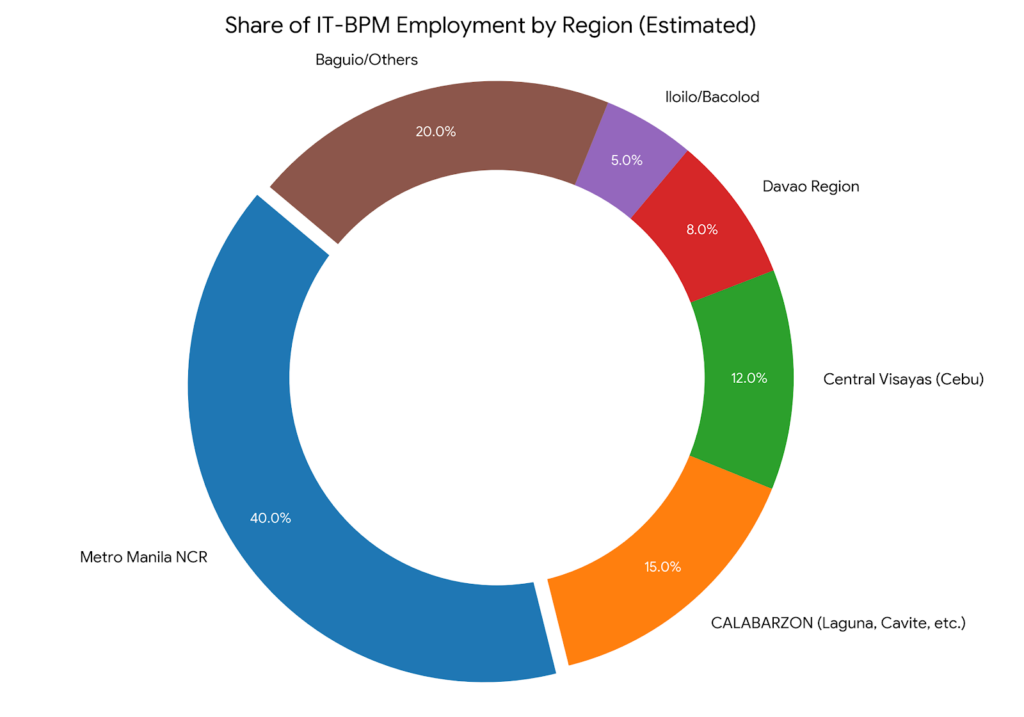
Figure: Approximate distribution of IT-BPM jobs by region (percent of 1.8 M total in 2024). Metro Manila leads, with major growth in secondary cities.
Talent Supply, Skill Gaps & Training
The Philippines produces a large number of graduates each year, including degree holders and vocational trainees, but industry leaders continue to point to a gap between graduate output and true job readiness. The challenge is less about the size of the labor pool and more about the alignment of skills with employer needs.
To address this, both government and industry have been investing in training and upskilling. TESDA partnerships and targeted programs, such as training tracks for virtual assistants, have helped prepare more workers for remote and offshore roles. Educational institutions are also adapting curricula to place more emphasis on digital skills, analytical thinking, communication, and applied technology.
Even with these efforts, specialized skills remain harder to find. AI and machine learning, advanced analytics, and cybersecurity are still relatively scarce compared with demand. That means employers hiring for more technical or emerging roles often need to invest in internal training rather than expecting a fully ready-made talent pool.
Recommendations for Employers
For employers looking to hire offshore talent in the Philippines successfully, a few priorities stand out.
Skill Development: Invest in training programs (e.g. partner with TESDA or professional institutes) to build needed skills in-house, especially for specialized roles.
Competitive Compensation: While still a savings winner, market-rate salaries and fringe benefits (healthcare, allowances) are key to retention. Consider performance bonuses or retention bonuses for critical roles.
Career Pathing: Create clear career ladders and mentorship. Show employees long-term growth within the company to improve loyalty.
Work Environment: Cultivate a supportive culture with recognition and employee engagement programs. Provide wellness initiatives to combat burnout.
Flexible Models: Leverage hybrid or remote staffing to widen the talent pool beyond major cities. This also addresses commuting burnout and can improve retention.
By understanding these roles and market dynamics – supported by statistics and industry reports – employers can better plan offshore hiring. The Philippines continues to offer a broad spectrum of skilled workers, but success demands addressing skill gaps and turnover proactively.
Build the Right Offshore Team with Offshore 24/7
The Philippines continues to be one of the strongest markets for offshore hiring, but getting results depends on more than choosing a role from a list. The real advantage comes from knowing which roles fit your business, where the talent is strongest, and how to build a team that can grow with you.
At Offshore 24/7, we help businesses identify the right offshore roles, structure teams around real operational needs, and hire talent in the Philippines with a focus on quality, scalability, and long-term fit. Whether you are building customer support, back-office operations, digital marketing, finance, or specialist technical teams, we help turn offshore hiring into a practical growth strategy.
If you are exploring offshore talent in the Philippines, Offshore 24/7 can help you assess role fit, hiring priorities, and the best structure for your next team build.